Blog
How to choose capital project document control software: 12 criteria

CEO & Founder, AODocs · Sep 23, 2026

Introduction
This guide is for Capital Projects Directors, Engineering Directors, Engineering Information Managers, Document Control Managers, and other enterprise application decision-makers. Choosing the right capital project document control software is critical for capital projects because it ensures that project information is accurate, traceable, and authorized for use throughout the project lifecycle. The right software helps teams avoid costly mistakes such as using the wrong revision, experiencing slow reviews, maintaining incomplete registers, and producing weak handover documentation. Capital project document control software is essential for managing the complexity and compliance requirements of large-scale engineering and construction projects.
Capital project document control software is a governed repository and workflow platform for identifying, reviewing, issuing, and retaining controlled project document records. For decision-makers, the key question is not just which system stores files, but which one can enforce required metadata, revision rules, approval roles, external collaboration controls, handover evidence, integrations, and operating constraints across the full document process.
Key takeaways
- A defensible shortlist starts with mandatory workflows, integrations, user roles, and required evidence.
- Observed pilot results, configuration, and licensing dependencies are stronger decision evidence than presentation claims.
- A mandatory-gate failure blocks the decision even when the aggregate score is positive.
What capital project document control and document management software is and is not
- Capital project document control software: a governed repository and workflow layer for identifying, reviewing, issuing, and retaining controlled project records.
- Capital project document control software manages engineering drawings, contracts, submittals, and specifications.
- Master Document Register (MDR): the controlled index of planned deliverables and the metadata, revision, status, and ownership used to manage them.
- Mandatory gate: an approved project requirement whose failure disqualifies an option, regardless of its aggregate score.
- Pilot: a controlled test that records observed results and evidence against approved pass conditions.
- Total cost of ownership: the buyer's view of relevant costs across the intended ownership period and exit, not only the subscription price.
Capital project document control software manages engineering drawings, contracts, submittals, and specifications. Transmittal and review records can connect an issue event to its documents, recipients, and approval evidence. The project still needs defined identifiers, code sets, decision rights, and operating controls. Document control software should not be assumed to replace planning, scheduling, cost control, BIM authoring, or field-execution platforms. Define integrations and system ownership instead of assuming one platform covers every project-control function.
Define requirements before creating a vendor shortlist
Defining the required scope is the first step in a defensible selection process. A VP of Business Applications should determine whether the primary need is internal design coordination, external contractor exchange, controlled issue, or asset handover, and whether an AI-native document management platform can support those requirements.
Folder-based storage may not provide the required status, workflow, and evidence. Before comparing products, document the decisions the system must support, current failure modes, mandatory integrations, user populations, and acceptance evidence. This makes fit gaps visible before a shortlist becomes a purchasing decision.
Twelve evaluation criteria
Below are the twelve evaluation criteria for capital project document control software. Each criterion is a distinct decision domain and forms an evaluation framework for this article. Treat a criterion as an eliminating gate only when the corresponding requirement was approved before the shortlist or pilot.
- Category scope and operating-model fit
- Register and metadata model
- Version, revision and status control
- Reviews and approvals
- Transmittals and external collaboration
- Comment closure
- Engineering viewing and comparison
- Permissions, security and audit history
- Completeness and handover
- Integrations, APIs and storage
- Migration, administration and adoption
- Commercial viability and exit readiness
1. Category scope and operating-model fit
Test:
- Map the document-control decisions required across the entire lifecycle in each lifecycle phase.
- Identify the accountable role and authoritative system for each decision.
- Confirm which responsibilities belong in the proposed platform and which remain in planning, cost, BIM, field-execution, or operational systems.
Eliminate if:
- The proposed operating model leaves a mandatory document-control decision without an accountable role or authoritative system.
- A required responsibility is assigned to a platform that cannot support it.
Selection error and consequence:
- Buying a broad project-platform label instead of defining the document-control boundary creates scope gaps, duplicated ownership, and conflicting records.
Evidence expected:
- An approved scope boundary
- Lifecycle responsibility matrix
- System-of-record map
- Requirement-to-capability matrix
- Register of gaps, owners, and approved workarounds
2. Register and metadata model
Test:
- Import a representative Master Document Register (MDR) with valid, missing, and invalid values.
- Test bulk changes, required fields, controlled values, duplicate identifiers, and export in the context of the core AODocs document management model.
Eliminate if:
- The platform cannot represent and preserve the required document identity, metadata, or validation rules within the approved operating model.
Selection error and consequence:
- Evaluating only folders, upload, and search hides metadata gaps.
- Duplicate or misclassified records can corrupt completeness reporting and the identification of current documents.
Evidence expected:
- Configured schema
- Source file
- Import log
- Validation exceptions
- Bulk-change history
- Exported records with stable identifiers
3. Version, revision and status control
Test:
- Run working-version, approved, reissued, withdrawn, and superseded scenarios.
- Check search, direct links, downloads, and exports to confirm which revision is current and authorized for each purpose of issue.
- Verify that version control holds across each state change using the drawing revision control guide.
Eliminate if:
- A mandatory workflow cannot distinguish formal revisions from working versions.
- A superseded revision appears as current in a required channel.
Selection error and consequence:
- Treating upload history or a watermark as revision control leaves status and authorization ambiguous.
- Teams may act on a noncurrent drawing while the audit trail appears complete.
Evidence expected:
- Document history
- Revision history
- Search and link results
- Representative exports
- Event records showing revision, status, purpose, actor, approving authority, and release date
4. Reviews and approvals
Test:
- Configure the project's required parallel or sequential path.
- Complete a representative review with internal and external roles, an exception, and an escalation.
- Attempt an approval and a path change with an unauthorized role.
Eliminate if:
- Required decision rights cannot be enforced.
- An unauthorized participant can approve.
- Workflow changes cannot be attributed and reviewed.
Selection error and consequence:
- Counting workflow steps or notifications as proof of governance can hide bypasses and uncontrolled configuration changes.
- The resulting approval record may not support the project's decision process.
Evidence expected:
- Approved workflow definition
- Permission matrix
- Complete workflow history
- Unauthorized-action result
- Exception record
- Documented configuration or licensing dependency
5. Transmittals and external collaboration
Test:
- Under the project's document transmittal workflow, issue a representative package to an external role.
- Record partial acknowledgment, reject or withdraw an item, and reissue the package.
- Include scenarios where emails and attachments are exchanged through tools such as the AODocs Gmail add-on for exporting messages to libraries.
Eliminate if:
- Formal exchange is mandatory and the platform cannot reconcile the exact package, document revisions, recipients, issue event, receipt state, response, and reissue.
Selection error and consequence:
- Treating an email, shared link, or portal upload as a complete transmittal record makes it difficult to reconstruct what each recipient received and what happened next.
Evidence expected:
- Package manifest
- Transmittal record
- Recipient and access records
- Timestamps
- Acknowledgment state
- Exception history
- Cross-reference to the reissue
6. Comment closure
Test:
- Create, assign, answer, reject, reopen, and close representative technical comments against an exact revision.
- Reissue the document and export the comment record.
Eliminate if:
- The required review process loses the link between a comment, its disposition, the responsible party, and the applicable revision or reissue.
Selection error and consequence:
- Treating a closed-comment count as proof of technical closure can conceal rejected responses or comments attached to an obsolete revision.
- Unresolved issues may then appear complete.
Evidence expected:
- Comment and disposition export
- Revision link
- Assignment and response history
- Reopen event
- Closure approval
- Record carried into the reissue
7. Engineering viewing and comparison
Test:
- Open and compare representative project files across every required format, page condition, and file profile.
- Record whether support is native, viewer-dependent, licensed separately, or unavailable.
- Compare results against project-approved expectations, including how easily users can download attached files from AODocs libraries for offline review when required.
Eliminate if:
- A critical format or review task cannot be completed in the supported configuration and no approved alternative workflow exists.
Selection error and consequence:
- Accepting a format list, integration logo, or prepared sample as proof of engineering usability can leave reviewers unable to render or compare real project files.
Evidence expected:
- Test inputs
- Rendered outputs
- Comparison results
- Timing against a project-defined threshold
- Excluded formats or pages
- Failure records
- Viewer or licensing requirements
8. Permissions, security and audit history
Test:
- Map representative roles to parties, document classes, and statuses.
- Test allowed and denied views, downloads, workflow actions, and metadata changes.
- Revoke access and export the required audit events, which may also be needed to ensure compliance with internal controls and industry standards such as ISO.
- In the proposed configuration, test required SSO and MFA paths and verify the stated encryption controls.
- Review supplier assurance, vulnerability management, incident response and notification, backup, business continuity, and disaster-recovery arrangements against requirements approved by security, legal, and procurement stakeholders, including regulatory compliance obligations where relevant, drawing on resources such as the AODocs FAQ covering licensing, assurance and support.
Eliminate if:
- Unauthorized access succeeds.
- A mandatory action is not attributable.
- An approved requirement for SSO, MFA, encryption, audit retention or export, vulnerability handling, incident response, continuity, or recovery cannot be met in the proposed configuration and contract.
Selection error and consequence:
- Inferring security from a certification statement or a role-name list can hide identity, encryption, revocation, logging, vulnerability-response, and resilience gaps.
- Sensitive records may be exposed, decisions may become unauditable, or an incident may interrupt access longer than the project can accept.
Evidence expected:
- Approved access matrix
- Allowed and denied test results
- SSO, MFA, identity and permission configuration
- Revocation result
- Full audit history export when required
- Encryption documentation
- Current supplier-assurance material with scope and date
- Vulnerability-management and incident-response procedures
- Notification commitments
- Evidence for backup, continuity, and recovery testing
9. Completeness and handover
Test:
- Build a representative handover package containing accepted, missing, invalid, under-review, and excepted records.
- Report it by system, area, or package.
- Have a receiving user retrieve and export the underlying records.
- Apply the capital project handover documentation checklist.
Eliminate if:
- Handover is in scope and the platform cannot report required items, acceptance states, and open exceptions or transfer them in the required form.
Selection error and consequence:
- Treating a document count or completion percentage as package acceptance can make an incomplete or unusable package appear ready for operations.
Evidence expected:
- Approved deliverable baseline
- Completeness and exception report
- Acceptance records
- Receiving-user retrieval result and export with required files, metadata, and open obligations
10. Integrations, APIs and storage
Test:
- Execute representative inbound and outbound exchanges, including mandatory exchanges with enterprise systems such as ERP, through each required API or connector.
- Verify authentication, field mapping, record identity, and ownership.
- Introduce a mapping or authentication failure and confirm monitoring, retry, and reconciliation.
- Confirm the integration supports consistent project data across systems and that required data flows remain intact.
- Store, retrieve, and export representative records in the proposed storage configuration.
- Verify applicable residency requirements with architecture and security stakeholders, including how AODocs uses Google Cloud Storage buckets for attached files and how administrators manage AODocs storage accounts in Google Workspace.
Eliminate if:
- A mandatory API, connector, exchange, monitoring, or reconciliation requirement fails end to end.
- An approved requirement for data ownership, export, storage, or residency cannot be met in the proposed configuration and contract.
Selection error and consequence:
- Trusting an integration logo, API existence, or architecture label can hide unsupported mappings, silent failures, duplicate ownership, and storage or exit constraints.
Evidence expected:
- Data-flow and system-of-record map
- API or connector documentation and logs
- Field mapping
- Failed and reconciled transaction
- Monitoring record
- Representative export
- Storage configuration
- Current contractual confirmation of relevant options
11. Migration, administration and adoption
Test:
- Migrate a representative legacy sample with metadata, versions, and exceptions.
- Reconcile completeness, identity, and history.
- Have the future administrator configure a field and search view and resolve a representative support request.
- Have users from each required population complete a core task with the proposed onboarding, training, and guidance.
- Compare the result with buyer-approved acceptance conditions, including any required field teams that need real time access to current project documentation because on-site workers must be able to view updated project documents.
- For AODocs, validate the deployment path described in the installation guide for Google Workspace domains.
Eliminate if:
- Required records or history cannot be migrated and reconciled.
- The future administration and support model exceeds an approved operating constraint.
- A required user population cannot complete a mandatory task under the approved adoption conditions.
Selection error and consequence:
- Evaluating migration with a clean sample, administration through a vendor specialist, or adoption through trained champions can hide exceptions and day-to-day ownership.
- The buyer may inherit unplanned manual work, orphaned records, poor uptake, or long-term service dependency for project managers and construction teams.
Evidence expected:
- Migration source and result
- Completeness reconciliation and exception log
- Administrator configuration and support records
- Required permissions
- Ownership model
- Training and onboarding material
- Support scope
- Representative-user results
- Documented follow-up actions
12. Commercial viability and exit readiness
Test:
- Verify the proposed offer and contract against the approved operating model for the intended ownership period and exit.
- Separate standard capability from configuration, licensing, and services.
- Build a buyer-owned cost model covering, where applicable, subscriptions, external-user access, configuration, migration, integrations, storage, training, support, retention, export, and termination assistance.
- Separate base cost from any additional cost tied to external users, storage, integrations, or support.
- Treat roadmap items as unavailable unless they are committed in the proposed contract.
Eliminate if:
- An essential capability, cost category, data-ownership term, export requirement, or exit condition remains unresolved.
- The complete cost model fails the buyer's approved constraints.
Selection error and consequence:
- Treating a customer reference, list price, or roadmap statement as proof of the proposed operating scope can understate total cost, dependency, and exit risk.
- Hidden dependencies can create additional cost over the ownership period.
Evidence expected:
- Verified reference notes
- Proposed configuration and licensing scope
- Proposal and contract terms
- Dependency register
- Buyer-owned cost model with assumptions and exclusions
- Tested export and exit evidence
Match the platform to the use case
Selection depends on the project phase, participant model, document types, and existing systems. The right platform fit also affects efficiency and governance, especially when teams manage multiple projects with different participant models and document types. A greenfield program may emphasize contractor exchange, design reviews, and creation of the initial asset record, and cloud-based capital project management software can help improve project efficiency in these environments, provided the platform meets the system and browser requirements for AODocs or any equivalent product in scope. A brownfield program may place more weight on legacy-data quality, operating access, and controlled modernization records, and owner operators may weigh those requirements differently across program types.
Demo scenarios that expose product limits
Why demo scenarios matter
- Include demo scenarios that expose limits in management software used for large capital programs, not just generic peak-volume conditions that matter to the target project.
- One demo does not establish future performance.
- Time-consuming manual work often only appears under realistic volume, format, and review conditions, especially when storage is hosted in services such as Google Cloud Storage buckets configured for AODocs libraries.
A measurable pilot scorecard
How to use a pilot scorecard
- Use a representative pilot to test every applicable criterion and mandatory gate.
- Set its duration, participants, and pass conditions from approved project requirements.
- Score observed document-control results to track progress, not assumed effects on schedule outcomes.
- Use pilot evidence to improve project visibility for decision-making.
- Do not prefill generic weights or benchmarks.
- If weighting is used, approve it before testing and calculate an aggregate score only after every applicable gate passes, with project performance included only where the approved pilot scope observes it.
- A row marked Not set cannot be scored.
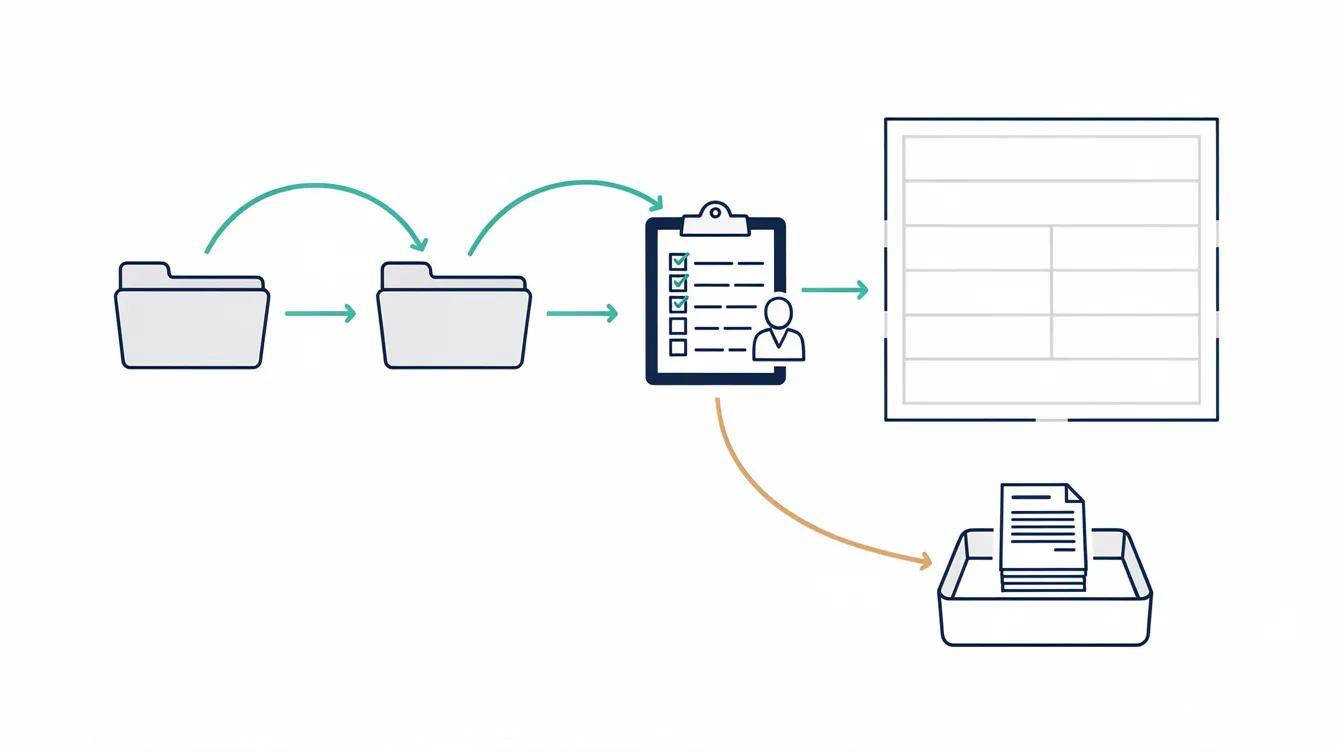
This framework is a project-specific method, not an industry standard. Use the CISA Software Acquisition Guide to inform supplier security evidence and acquisition questions. Where generative AI is in scope, use the NIST AI Risk Management Framework 1.0, NIST AI 100-1, January 2023 and the NIST AI RMF: Generative Artificial Intelligence Profile, NIST AI 600-1, July 2024 as risk-management references. As a project-specific recommendation for the pilot, test representative and unsupported queries, source traceability, and human escalation against buyer-approved acceptance conditions. These scenarios are not NIST-prescribed pass thresholds.
| Criterion | Gate applies when | Approved pass condition | Observed result | Evidence reference | Dependency | Decision |
|---|---|---|---|---|---|---|
| 1. Category scope and operating-model fit | A document-control responsibility or system-of-record boundary is mandatory | Not set | Not tested | Not recorded | Scope, lifecycle and ownership model | Pending |
| 2. Register and metadata | Controlled identity and fields are required | Not set | Not tested | Not recorded | Import and validation | Pending |
| 3. Revision-state integrity | Formal revisions and authorized states are required | Not set | Not tested | Not recorded | Viewer and workflow | Pending |
| 4. Review and approval | Controlled project decisions are required | Not set | Not tested | Not recorded | External access and workflow | Pending |
| 5. Transmittal workflow | Formal external exchange is required | Not set | Not tested | Not recorded | External user model and workflow | Pending |
| 6. Comment closure | Technical comments affect acceptance | Not set | Not tested | Not recorded | Review configuration | Pending |
| 7. Viewing and comparison | Engineering review requires defined file support | Not set | Not tested | Not recorded | Viewer and licensing | Pending |
| 8. Security and audit | Access and attributable history are mandatory | Not set | Not tested | Not recorded | Identity, retention and audit | Pending |
| 9. Handover completeness | Turnover to operations is in scope | Not set | Not tested | Not recorded | Reporting and export | Pending |
| 10. Integration and storage | An exchange, export or storage constraint is mandatory | Not set | Not tested | Not recorded | API, connector and storage | Pending |
| 11. Migration, administration and adoption | Legacy data or a defined operating model is required | Not set | Not tested | Not recorded | Migration, admin and training | Pending |
| 12. Commercial viability and exit readiness | Procurement requires verified scope, cost across the intended ownership period and exit controls | Not set | Not tested | Not recorded | Licensing, services and contract | Pending |
Claims that trigger further verification
- Treat absolute compliance promises or AI accuracy claims without documented error boundaries as unverified.
- Governance is a human-led process supported by technology, not a replacement for it.
- If a vendor promises a migration with no risk or an implementation duration before inspecting the Master Document Register or equivalent approved deliverable baseline, where applicable, require technical evidence.
- For any generative AI assistant included in the product scope, test representative questions, unsupported questions, and adversarial prompts.
- Record source coverage, unsupported answers, and escalation behavior.
- A demo can reveal failure modes, but it cannot prove the future absence of fabricated answers.
Where the platform fits
AODocs' Document Control documentation describes metadata, lifecycle, workflow, permissions, and version control for construction document control software. Its Engineering and Construction page describes capital-project capabilities. Storage options do not have feature parity: current AODocs documentation lists functional limitations for some GCS-, Azure Blob- and SharePoint Embedded-backed libraries. Verify storage, viewer activation, external access, integrations, API coverage, and whether the platform integrates natively with required systems or depends on separate integration and API work, along with licensing, in the pilot.
Learn more
Frequently asked questions
How should capital-project software identify the document issue authorized for use?
Show the document identifier, business revision, status, purpose of issue and approval or release evidence together. A later system version or upload timestamp is not proof of authorization. Test approved, review-only, withdrawn and superseded examples through search, direct links, downloads and exports using recipient roles. Define the authorized-use rule and pass conditions from the project requirements.
What should a document control software pilot test?
Use representative documents, metadata, roles, and external participants. Test revision status, approval, transmittal, restricted access, reports, export, and handover evidence against agreed acceptance criteria.
How should an integration claim be tested before buying document control software?
Run a representative exchange with the proposed connector, roles and records. Verify authentication, field mapping, document identity and system ownership. Introduce a failure, then inspect monitoring, retry and reconciliation. Confirm licensing and support responsibility, and test any required reverse exchange separately. An API or integration logo does not establish working synchronization.
When is document control software not the right tool?
It is not necessarily the system of record for planning, scheduling, cost control, BIM authoring, field execution, project management, or project controls. Define which system owns each decision and how approved document information moves between them, since the right software depends on that ownership.