Blog
Capital project handover documentation checklist

CEO & Founder, AODocs · Sep 25, 2026 · Updated Oct 6, 2026

1. What capital project handover documentation is
Capital project handover documentation is the controlled set of records and asset data transferred from project delivery to operations, and a capital project handover documentation checklist is the controlled list used to make sure required documents and data such as as-built drawings, operation and maintenance manuals, equipment data, and commissioning records are prepared, verified, linked to project requirements, and accepted before that transfer. Terminology varies by contract. The U.S. Department of Energy Project Completion/Closeout Guide treats turnover to the operating organization separately from later administrative and financial closeout, but that federal model is not universal. Project closeout may also continue after practical completion, so turnover and closeout should not be treated as the same milestone. Define the project's terms, required deliverables, acceptance evidence and responsible roles before applying this checklist.
For Capital Projects Directors, Engineering Directors, Engineering Information Managers, and Document Control Managers handling complex projects with high document volumes and strict handover requirements, the issue is operational readiness: missing, unverified, or poorly indexed handover records create traceability gaps, delay startup, and weaken compliance and asset-management decisions. Scope: this checklist covers document and data handover. It does not replace physical inspection, commissioning sign-off, safety review, occupancy approval or contract closeout. The sections that follow explain what belongs in the handover set, why planning starts early, where handovers fail, and how to build and control the checklist across document families, metadata, asset links, completeness tracking, staged turnover, final validation, and retrieval testing before project closeout.
What belongs in capital project handover documentation?
A handover package may include design and construction records, record or as-built drawings, operation and maintenance manuals, equipment data, warranties, test and commissioning records, and permits required by the contract or governing authority. Document-package acceptance does not by itself establish physical completion, operational readiness, safe operation or legal compliance.
Key takeaways
- Define every required deliverable, metadata rule, format, acceptance role and evidence before documents arrive.
- Track required, received, under-review, accepted, excepted and overdue items separately.
- Test retrieval, export and receiving-team access with a representative package before the final handover milestone.
2. Why handover requirements start at project setup
Handover planning can begin with the project information requirements and a master document list (MDL) during setup as part of a structured process. Late definition makes it harder to distinguish missing deliverables from documents that were never required, and many teams break that process into six stages from setup through transfer.
Define the deliverables list, metadata rules, accepted formats, accountable roles and approval evidence during project setup. Then track each required item as planned, received, under review, accepted, excepted or overdue.
A controlled checklist can be sufficient for a stable scope with few contributors and a short acceptance chain. Formalize the requirements matrix, workflow and exception tracking when the work involves several suppliers, multiple packages, progressive transfers, structured asset data or interfaces with receiving systems. The decision should follow the project risk and information requirements, not a generic size threshold.
3. Common handover documentation errors, consequences and controls
| Typical error | Consequence | Recommended control |
|---|---|---|
| Defining handover requirements near the final milestone | The team can no longer distinguish a missing deliverable from one that was never included in the baseline, and tight deadlines can force rushed handovers and incomplete documentation | Define the deliverables, metadata, formats, owners and acceptance evidence during project setup |
| Treating a checked box as proof of completion | The checklist can appear complete without an accepted record, decision event or recorded exception | Link every checked item to its final evidence and retain approved baseline changes |
| Reporting one completeness percentage without context | Missing scope can be hidden when the denominator, status meanings or cut-off date are unclear | Report required, received, under review, accepted and excepted items separately and disclose the calculation boundary |
| Treating a readable file as accepted data | Required fields, approved values or asset identifiers can remain invalid even when the file opens | Define and test file acceptance and data acceptance separately |
| Treating document-package acceptance as operational readiness | The record can imply physical completion, safe operation or legal compliance that document control does not establish | Keep documentary acceptance separate from commissioning, inspection, safety and contractual decisions |
| Validating only an administrator export | Operators may still be unable to retrieve the right record after transfer because identities, links, metadata or permissions differ | Test representative operational tasks with the receiving users, devices and systems |
In practice, delayed handovers can trigger financial penalties or legal actions.
A successful handover helps reduce disputes and improve client satisfaction, especially when supported by an AI-native document management platform that standardizes records and governance across projects.
4. How to prepare handover documentation correctly
Build a handover requirements and evidence matrix
Start with the controlled requirements baseline. Connect each deliverable to its owner, status, acceptance evidence, and receiving task. This approach ensures the package is verifiable from project setup through transfer.
Define handover requirements before documents arrive by turning each contract or owner requirement into a controlled row. The row should capture clearly defined information requirements agreed early, including:
- The deliverable
- Responsible party
- Due event
- Required format
- Metadata
- Acceptance role
- Evidence
- Naming conventions for deliverables and metadata
Link each requirement to the MDR or MDL identifier used during design and construction.
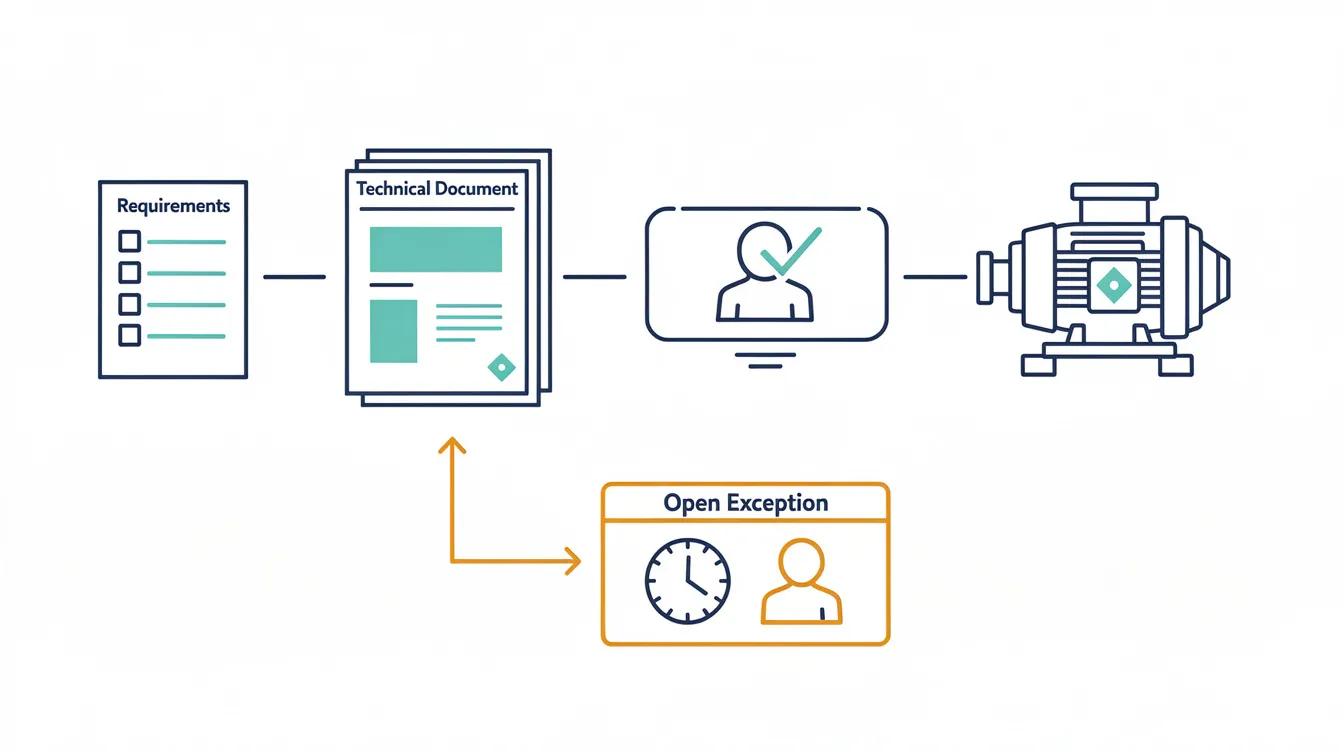
Avoid using a blank checklist as proof of completion. Each checked item should point to the accepted record, decision event, or recorded exception. If a requirement changes, retain the approved change and its effect on planned deliverables rather than overwriting the baseline. The defined information requirements remain the reference, and the agreed handover requirements are the benchmark for acceptance evidence.
| Matrix element | Decision to record |
|---|---|
| Deliverable | Exact record, data set or package required |
| Scope link | Contract, owner requirement, system, area or asset in scope |
| Responsible party | Organization or role expected to provide the item |
| Due event | Milestone or project-defined date that triggers delivery |
| Acceptance rule | Required format, metadata, revision, status and review evidence |
| Final evidence | Accepted record, decision event or open exception |
Reconcile the matrix at project-defined gates. Report required, received, under review, accepted and excepted items separately. A percentage without its denominator, status definitions and cut-off date can hide missing scope.
Document and data families to define
Document families organize records into logical groups based on their purpose and lifecycle. For example:
- Design documents include architectural, structural, and mechanical drawings that evolve through several controlled revisions.
- Construction documents capture the physical execution, such as daily reports, inspection records, and material certifications.
- Operational documents focus on the long-term utility of the asset, including spare parts lists, preventive maintenance schedules, operation manuals, and handover forms when the contract requires them within those document families.
Each family may require different metadata for search, traceability, and acceptance in the governed repository. The handover team should test the classification against its review tasks. Problems often recur when teams classify files late or without controlled family rules.
Define file and data acceptance separately:
- A readable PDF may satisfy a visual record requirement but not a structured asset-data requirement.
- A spreadsheet may contain required fields while still using unapproved values or identifiers.
- Record which checks are automated, which require human review, and which depend on a technical authority outside document control.
How documents connect to systems, assets and equipment
A functional handover links project information governance to the full asset lifecycle. Where the information requirements call for asset linkage, each relevant document should reference a system, location, asset or equipment identifier and, where required, connect structured asset information to each physical asset.
This connection allows operations teams to retrieve technical specifications or maintenance history by searching for an asset tag or equipment identifier. Maintenance teams use that asset information in operational systems after transfer. Maintaining that relationship can make records easier to retrieve after turnover.
The receiving team should verify the links using its own asset identifiers and tasks. This helps support the completed asset beyond the project lifecycle.
Statuses, acceptance criteria and ownership
Status values are not static industry defaults. The project document plan and handover plan should define their meanings, permitted transitions, relationship to final package requirements, and ownership before the handover stage. Assign an accountable role to each deliverable or package.
Acceptance criteria determine when a record is current and acceptable for the assigned purpose; they do not create a universal standard. Clear ownership gives the project team an escalation path and a source for each record. Clear accountability at this stage supports a smooth transition into operations.
How to track completeness and exceptions
The master document register provides a mechanism to monitor the project deliverables list against actual submissions. A controlled comparison identifies gaps between the planned master document list and the documents received from suppliers. That completeness tracking is part of measuring handover readiness throughout the project rather than waiting for the final weeks.
When a document fails its assigned acceptance criteria, log an exception. Record the missing data, incorrect metadata, or other unmet requirement without labeling the item legally non-compliant unless a verified regulatory requirement applies. Tracking completeness requires comparison between required deliverables, received records, review status, exceptions, and accepted files in the governed repository.
| Control | Question | Evidence |
|---|---|---|
| Metadata integrity | Does the record match the required asset or system identifier? | Validated metadata fields |
| Revision status | Is this revision authorized for the stated purpose? | MDR status and recorded approval event |
| Completion | Are all required approvals and signatures present? | Recorded approval events and required signatures |
Exception logging keeps incomplete items visible and records what remains open, who owns it and what evidence will close it. Report document-package status from that record. Many handover failures stem from gaps in asset records and unresolved exceptions. Do not label the asset operationally ready on document-control evidence alone.
How staged turnover works by system, area or package
Where the project uses staged turnover, define packages by system, area, or contractor scope as part of the broader construction handover process and a documented construction project handover plan. This should be supported by clearly defined workflows to manage review and approval steps.
Early package boundaries allow review to occur before the final handover milestone and make cross-system dependencies visible. Package planning should identify key steps, responsibilities, and end dates for each package. Where the contract assigns that role, the general contractor or construction team should own package boundaries.
Staged turnover does not prove completeness. Each package still requires an accountable review against its acceptance criteria, open exceptions, and delivery plan.
Final validation and transfer to operations
Compare the deliverables list with the records received. Verify through final inspections that each required file is readable, correctly indexed, and associated with its recorded revision, status, and acceptance evidence before transfer.
When final documents are issued as packages, retain the associated document transmittal so the exact revisions, recipients, and issue evidence remain connected to the handover record. A formal handover usually follows practical completion once completed works and documentary requirements are verified.
Record the receiving location, transfer date, and accountable receiving role. The receiving team should test access using its operational tasks and verify that AODocs documents and their metadata remain usable for those tasks after transfer. Document acceptance confirms the completed asset record, but does not certify physical completion, safe operation, or legal compliance on its own.
Record package acceptance and residual obligations
For each package:
- Record its identifier, scope, accepted records, reviewer, and acceptance date.
- Log every open exception with an owner, due date, and residual obligation, such as the defects liability period that may start at acceptance.
- Record the receiving-system location and applicable supersession rules.
Package acceptance is separate from physical completion and final contract closeout. Formal closeout financial summaries are also part of project completion documentation even when package acceptance is already recorded. A governed repository records the evidence; it does not guarantee the accuracy of engineering data or a project outcome.
Test retrieval, export and receiving-team access
Test the handover path before the final milestone with a representative package. Use the permissions, device, and receiving system expected in operations. As a practical handover checklist, ask receiving users to:
- Find a current drawing
- Locate an operation and maintenance manual
- Retrieve a warranty
- Access an equipment record
- Review the evidence attached to an accepted package
For each task:
- Record the query or navigation path
- Note the expected result
- Observe the actual result
- Document any corrective action
Check that superseded records remain distinguishable, links resolve after transfer, and required metadata survives export. Open representative files rather than validating only file names or counts. Where process-plant data must be received in a structured form, note that ISO 15926 supports lifecycle integration of process-plant information.
An export test should define its boundary. Confirm which files, metadata, relationships, workflow events, and audit records are included, especially when using an AODocs REST API integration for transfer. Record what remains available only in the source platform and how it will be retained. If an API or connector performs the transfer, test authentication, field mapping, rejected records, retry behavior, and reconciliation.
Receiving-team access is a separate check. Confirm identities, roles, storage location, search fields, utility accounts, and support ownership after project-team access changes. Validate that operators can download attached files from governed records when required. A successful administrator export does not prove that an operator can retrieve the right record for a maintenance task.
Run a controlled exception scenario as part of the test:
- Omit one required file
- Provide one unreadable file
- Use one invalid asset identifier
The process should surface each issue without marking the package complete. Record who can accept a residual obligation and what evidence closes it later.
A 15-point handover documentation checklist
Use the following checklist as a project template. Adapt every item to the contract, information requirements, and package acceptance criteria before use. Review missing records and unresolved exceptions explicitly before turnover rather than assuming a checked list proves completion.
- Verify that all submitted deliverables match the specific project contract requirements.
- Map every submitted document to the master document register or master document list.
- For records that require asset linkage, confirm the required system, location, asset or equipment identifier.
- Confirm that each file carries the revision, status and approval evidence required for its stated purpose.
- Verify as built documentation against the project's defined acceptance method so it reflects final field changes.
- Check required operation and maintenance manuals against the deliverables list.
- Collect vendor data and equipment specifications required by the deliverables list, including each warranty start date, coverage terms, claim procedure, and expiration tracking. Missing warranty records can make coverage and claim requirements harder to establish.
- Consolidate all test and commissioning records for each functional unit or area, including input from commissioning teams and test certificates for building systems.
- Include permits and safety certifications required by the contract or governing authority.
- Include detailed training records for operations personnel where required by the project contract.
- Document all open exceptions and establish a clear timeline for their future resolution, including post-acceptance follow-up where latent defects may need to be addressed.
- Assign an accountable acceptance role for each package.
- Set access permissions to align with operational security and information governance requirements.
- Test a representative export or transfer and record missing, corrupted or unreadable data.
- Obtain receiving-team acceptance for the approved contents and record any residual obligations.
Sources and scope
The GSA Real Property Management business standards and the primary RPM business-lifecycle record illustrate asset acceptance, turnover-document evaluation, commissioning reports and completion evidence in a US federal context. They do not define universal project requirements. NIBS' current NBIMS-US V4 resources list COBie Version 3, while the COBie purpose page explains its use for maintainable-asset data at handover. COBie is not a universal requirement.
Where the platform fits
AODocs Engineering and Construction documents MDL import, placeholders, automated numbering and overdue-item tracking. AODocs Document Control describes configurable document lifecycles, version control, workflows, permissions and metadata. These capabilities may support an MDR or MDL handover process, subject to configuration, licensing, data quality, integrations and process ownership. A representative pilot must verify export contents, field mappings, audit records and receiving-user access. AODocs does not certify package completeness or replace commissioning, planning, scheduling, cost control, BIM authoring or field execution, but its broader AI-powered document management capabilities can support standardized, governed handover documentation.
Learn more
Frequently asked questions
What is included in construction handover documentation?
A turnover package for a construction project may include as-built drawings, operation and maintenance manuals, equipment data, warranties, commissioning records, and other asset information needed for operations as part of the wider project closeout process. These are some of the key components, but the contract and project information requirements define the actual deliverables and acceptance evidence.
How to prepare a handover checklist?
Turn each capital-project handover requirement into an identifiable deliverable with an owner, due event, format, metadata and acceptance rule. Link each item to its accepted record or open exception. Report required, received, under-review and accepted items separately. Test retrieval and transfer with the receiving operations team before declaring the document package complete.
What is the difference between closeout and turnover?
Projects may use closeout for completion of contractual and administrative obligations and turnover for transfer of the asset and its records. Definitions vary, so the contract and project document plan should state how each term is used.
Does an accepted handover document package prove the asset is ready to operate?
No. Documentary acceptance confirms that the agreed records and data have been reviewed or accepted within the package scope. Physical completion, commissioning, safety and operating authorization need their own evidence and accountable decisions. Keep those milestones separate, and record any remaining obligations or exceptions against the accepted package.