AI
Legacy Systems: Are You Missing Out on Gen AI Document Processing Opportunities?

Solution Consultant - Presales, AODocs · Oct 8, 2024 · Updated Oct 6, 2026

What’s the real price of standing still?
On paper, keeping legacy IT systems using software licenses purchased long ago seems cost-effective. After all, the tool is available to the whole company for a reasonable yearly maintenance cost.
But what is the cost of constantly pushing back business user requests for new use cases? And what about delaying process updates because the system is too rigid? What is the price of being blocked from integrating the old system with the latest applications?
Or of not being able to leverage modern AI?
A modernization assessment should include document-system maintenance and security responsibilities, together with integration requirements for the proposed environment. Quantify those requirements using your deployment rather than treating general survey figures as its business case.
Indirect costs require measurement. Include administration, integrations and manual document-processing work in the assessment.
Explore planned migration to AODocs
The true cost of legacy systems
Legacy systems such as IBM FileNet, Hyland OnBase, OpenText Documentum or Microsoft’s SharePoint must be evaluated by exact release and deployment. Current product options can differ substantially from an older installation. IBM's current FileNet offering, for example, describes generative AI, cloud-native deployment and APIs. Compare your required tasks against current documentation and a representative pilot rather than assuming limitations from the product's age.
Check support and maintenance obligations for the installed product and its dependencies. Include updates, administration and any contracted extended support in the operating-cost model. Compare supported upgrade and integration options with replacement before committing to a migration.
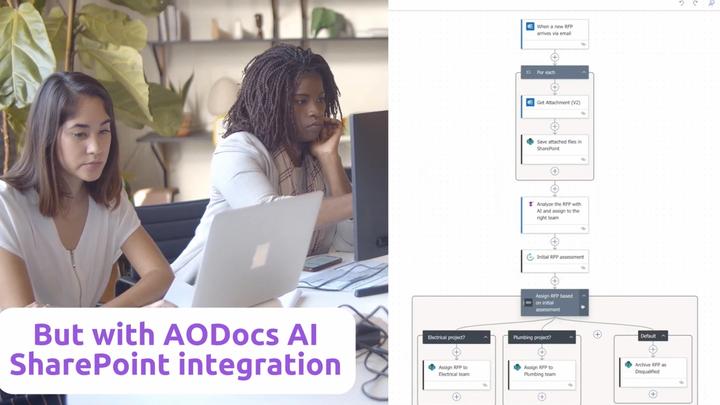
AI availability depends on the product, release, licensing and integration. A configured Power Automate flow can use an AI Builder document processing model, and IBM describes generative AI in its current FileNet offering. Check the required classification, extraction or summarization task in your own environment; replacement is not always necessary.
A smarter solution
AODocs is a document-management option to evaluate against the required controls and processing tasks. Confirm storage choices, deployment scope and scale limits with the provider for the proposed environment rather than relying on this article's historical AWS roadmap statement.
You stay in control: but you’re no longer stuck.
Evaluate generative AI against a defined document task and a governed set of source files. AODocs describes document understanding and assistant functions, but the configured workflow must establish access, review and exception handling. Test results against human-checked examples; source governance does not eliminate model error.
AODocs provides integration options for business applications. Confirm the required SAP, Salesforce or other application interface, authentication and data mapping for the proposed deployment. Test document status and access alongside file transfer; centralization does not automatically remove duplicates or establish security.
Compare the measured costs and constraints of the current environment with supported modernization and replacement options. Treat proposed productivity gains as estimates until a pilot verifies the selected document process.
Learn more
Frequently asked questions
Should an organization replace its document system before adding generative AI?
Replacement is not always necessary. Start with the document task, the installed product version, access controls and available integration options. Current FileNet offerings include generative AI capabilities, and Power Automate supports document processing models. Compare a targeted integration with replacement against your actual workload, governance requirements and operating costs.
What should a legacy document AI pilot test?
Test one defined task on a representative set of approved documents. Include poor scans, missing fields, conflicting versions and restricted files. Compare extracted values with a human-checked reference, record exceptions and confirm that the workflow can return unresolved items to an owner. Set acceptance thresholds before extending the pilot to business-critical decisions.
Which costs belong in a document system modernization business case?
Include more than license fees: support, infrastructure, administration, custom integrations, document cleanup, migration testing and user training. Compare those costs with measured time spent on the selected document process. Treat proposed productivity savings as estimates until a pilot verifies them, and include the cost of operating old and new systems during transition.