AI
Intelligent Document Processing: Gen AI vs Pre-generative OCR

CTO / Head of Engineering, AODocs · Sep 24, 2024 · Updated Oct 6, 2026

Generative AI adds options for enterprise document processing, but suitability depends on the documents and the task.
Automating manual tasks has been one of the central promises of Document Management solutions since their early days. In that sense, “Artificial intelligence” allowing machines to read unstructured documents is nothing new. In 1965, the IBM 1287 computer processed paper checks and other financial records.
In the 1980s and 1990s, document management systems likeIBM FileNet,OpenText Documentum, and OnBase began touting AI capabilities. Early claims were perhaps more geared towards marketing than substance. Features like automated indexing and document classification were depicted as “intelligent.”
As machine learning and natural language processing advanced, document processing gained new classification and extraction methods. Generative models add another option for interpreting variable content, alongside OCR and task-specific processing.
Let’s compare narrow AI and generative AI regarding practical use cases for your business document and enterprise content management.
Narrow AI: High volume of documents / small number of formats
Optical Character Recognition (OCR) converts document images into text. Zonal OCR targets defined areas of a page for extraction. That approach can support repeated processing of documents with stable layouts, while other extraction methods handle different content and format requirements.
For a template-based approach, configure the locations and fields to extract, then test representative inputs. This setup requirement does not apply identically to every OCR or document extraction method.
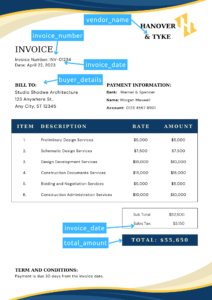
Once you fulfill this time-consuming teaching, your AI can look at large volumes of similar documents corresponding to a small number of well-known formats.
The result is an affordable and repetitive way of processing enterprise content such as tax returns, delivery orders or invoices from your existing providers.
However, it has its limits. A fixed extraction template needs testing when a document layout changes.
A stable template can suit recurring documents. If layouts vary, compare other extraction methods using the required fields, document quality and review effort rather than assuming that a template is sufficient.
Gen AI: Getting the unknown under control
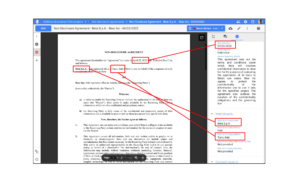
Generative extraction offers another way to interpret variable text. It can process content from supported document inputs without relying only on fixed field locations. Consider, for example, a contract where the information that needs to be extracted is mixed and embedded with the document’s textual content, with no specific formatting that can be “taught” to the tool.
Gen AI can make a big difference in your company’s ability to extract value from information when deployed on the right document and data. It is worth evaluating on varied layouts. Compare processing time, cost and ongoing review against the requirements of the workflow.
Model choice affects document processing costs and behavior. Compare available models on representative documents, including the cost of extraction, review and corrections. A newer model does not establish lower cost or higher quality for every workload.
With these developments in mind, you can see why it may make sense for a business to implement Gen AI assistants and chatbots. These tools can retrieve controlled information for insurance claims, RFPs or engineering projects. Source restrictions and answer evaluation are still needed before the output informs a decision.
Generative AI and task-specific methods have different strengths. Compare extraction accuracy, supported formats, permission handling, operating costs and maintenance effort on your documents before choosing an approach.
Summary
- Until recently, narrow AI might have been a good enough solution if you needed to process documents with well-known formats in volume at a low cost.
- For variable inputs, generative extraction is one option to test alongside other processors. OCR can remain part of the pipeline, and the best fit depends on the task and the observed results.
- Choose the processing pipeline that meets the workflow’s requirements, using representative tests rather than assuming generative AI suits all use cases.
Find out more
- Trusted Gen AI for ECM and DMS by AODocs
Frequently asked questions
When is template-based extraction a reasonable choice for document processing?
Template-based extraction is worth evaluating when documents use stable layouts and the fields appear in predictable locations. Test representative scans and layout changes before choosing it. The fit depends on the inputs and the required accuracy, rather than on whether a technique is described as older or newer.
Can generative document extraction replace OCR for every input?
Generative extraction is not a universal replacement for OCR. OCR converts document images into text, while extraction identifies fields or meaning from content. A processing pipeline can combine these functions. Supported formats, image quality and the chosen processor still limit what the system can handle.
How should teams compare OCR and generative extraction on their documents?
Run both approaches on a representative test set with reviewed reference answers. Compare field-level accuracy, missing values, review effort, processing time and cost. Include unfamiliar layouts and poor scans. Choose the approach that meets the workflow's requirements, rather than assuming one method performs better on every document.