AI
Why AI Agents Fail Midway: Content and Workflow Controls

CTO / Head of Engineering, AODocs · Jul 4, 2026 · Updated Oct 14, 2026
If an AI agent fails midway across websites, inboxes, calendars, and SaaS tools, first identify the failing step and whether its last action completed. Check tool access, inputs, service errors, and saved state before retrying. For document-based answers, also check that the retrieved source is applicable and current. This article examines both workflow recovery and the document controls that support reliable retrieval; a DMS alone does not fix every integration or model failure.
Imagine a major company deploys an enterprise AI assistant to streamline information access. Three months later, they discover that employees have been applying outdated policies, answers pulled directly from obsolete documents in their company shared folders.
The AI sounded confident and the document was real, but the source was obsolete. This example illustrates a source-selection failure. An assistant can also misinterpret a valid source or invent unsupported content, so both retrieval and answer quality need testing.
The Tow Center for Digital Journalism tested eight AI search tools on news-source identification. Across 1,600 queries, the tools collectively answered more than 60% incorrectly. That experiment concerned identifying news articles, publishers, and URLs; it is not an enterprise-agent failure rate. It supports checking citations, not a claim that a governed repository eliminates wrong answers.
Without a solid knowledge foundation, early AI wins can obscure serious threats. The rest of this article examines why AI assistants fail on governed content, how document validation and version control improve reliability, what outdated or disorganized repositories break, and how to implement a modern Document Management System that gives AI better answers and more dependable actions.
When the AI Pulls the Wrong Thread: Understanding Agent Failures
A document answer can fail because the assistant selected the wrong source. Consider a hypothetical analyst asking for Q2 revenue projections. A search might show several versions, while a generated answer could conceal that distinction if it does not expose the source and its status.
"What are our Q2 revenue projections?"
The assistant responds instantly with a precise figure and breakdown, sourced from an outdated draft that was superseded two weeks ago. No red flags. No footnotes. Just confident misinformation. The AI didn't invent numbers. It pulled from a real document, just not the right one. In regulated industries or high-stakes environments, this mistake isn't academic. It can lead to legal risk, financial missteps, and reputational damage.
When AI Meets Poor Information Management
AI assistants and other AI systems amplify whatever information ecosystem they inherit in production systems, especially when an agent operates independently across websites, inboxes, calendars, and SaaS tools. If your document environment is chaotic, full of duplicates, drafts, outdated templates, and mislabeled files, the AI won't magically fix it. It'll just surface those problems faster and spread them more efficiently.
In real workflows, a multi-tool workflow adds fragile integration points, so tool errors, rate limits, and network drops create additional failures and compound agent failures in enterprise production environments. Browser and scraping steps also break when dynamic page updates or layout changes invalidate a selector, and repeated retries can trap the tool in loop failures unless each integration has its own health checks and error handling.
Control the source set before retrieval
Unlike traditional search, where users assess and compare documents themselves, AI assistants return single, packaged answers. That's powerful, but it's also dangerous if the underlying content isn't validated and properly governed. And because generative models don't inherently understand which version is authoritative, they may pull from:
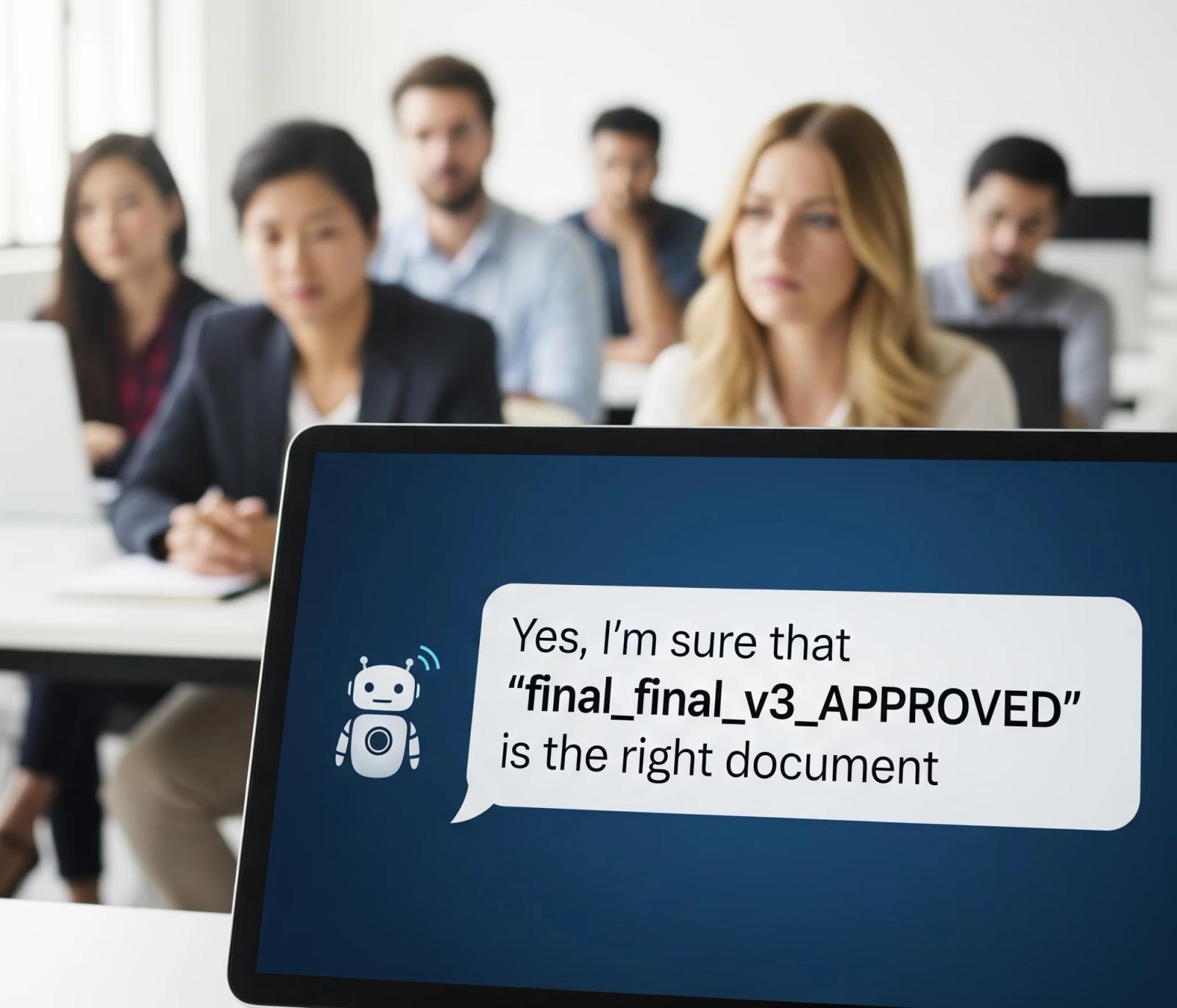
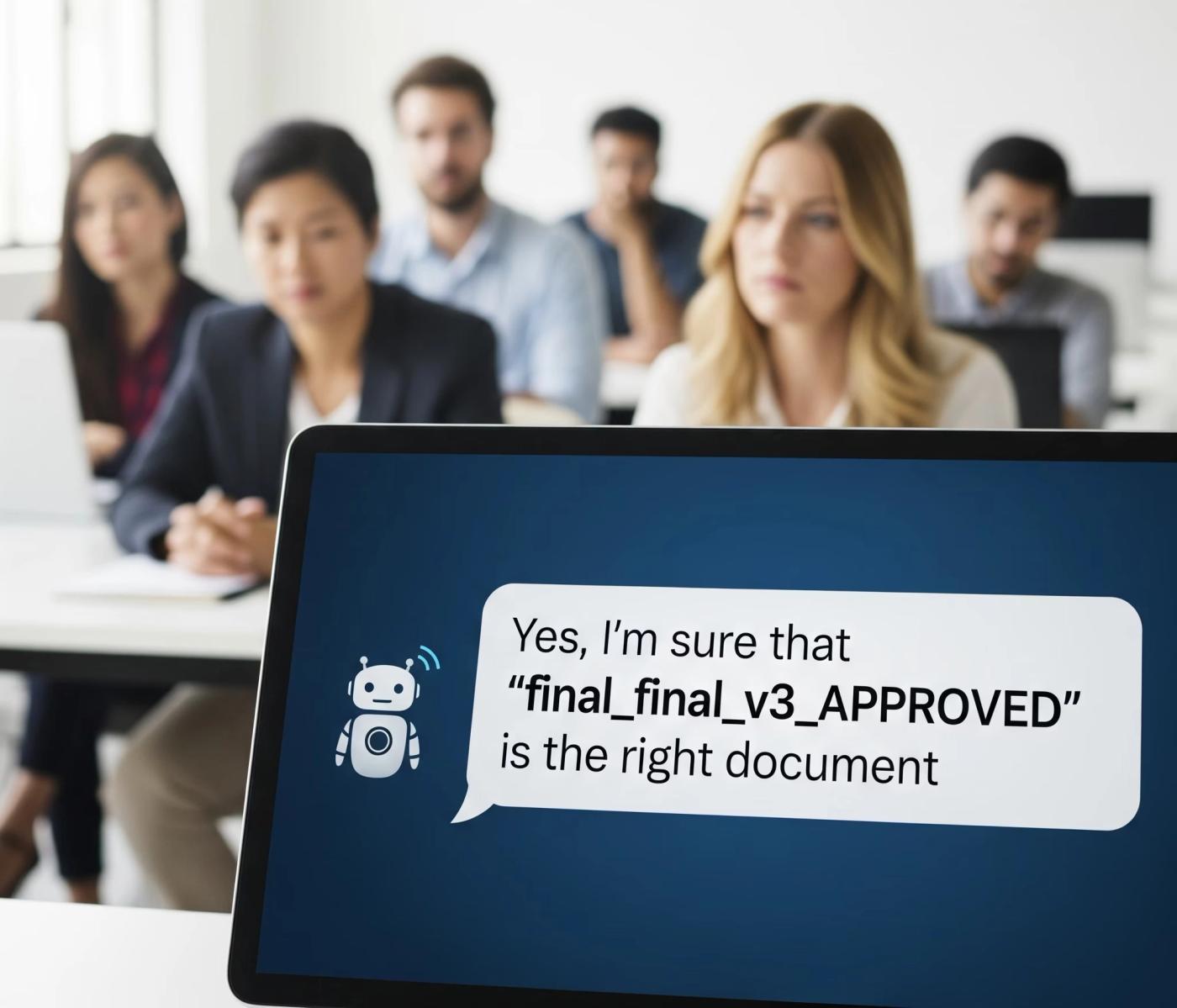
- A draft marked "final_final_v3_APPROVED"
- A policy awaiting legal sign-off
- A contract from 2017 with outdated terms
Long runs can lose relevant context as inputs accumulate. Keep a durable record of the task, completed steps, unresolved issues, and source versions. Before resuming, check whether the information or authorization has changed.
Validate the structure of a tool result before consuming it, then check the values and their meaning for the task. A result can match a schema and still be wrong or unauthorized. Separate format checks from source validation and approval.
An uncertain answer should be visible as an exception that the responsible person can investigate.
Documents Drive Business. AI Can Drive Results.
AI document tools can help prepare reviews, locate policies, and classify records. Quality teams can review suggestions about similar procedures. Finance and procurement teams can validate proposed invoice fields. Healthcare professionals need to verify that a retrieved record is applicable and current; clinical judgment remains separate. Engineering teams should check drawing revision and permitted use. Claims teams can evaluate retrieval against handling time and correction effort. Test each use before drawing conclusions about speed or quality.
Measure end-to-end completion on the workflow you intend to run. Record failed steps, incorrect actions, recoveries, and cases that required intervention. Results from unrelated benchmarks do not establish an expected failure rate for your agent.
Applicable source documents are one prerequisite for useful answers. The model and workflow still need evaluation. Start by checking the following:
- Your most important content is accurate and discoverable
- Document versions are clearly tagged and governed
- Obsolete drafts and superseded files are flagged or removed from AI access
- Your knowledge base is structured, centralized, and AI-ready
Preserve workflow state and govern the source documents
Whether you build an agent or use a provider, retain durable task state and distinguish an intended action from a confirmed result. A database transaction can keep related local updates together, but it does not make writes across separate SaaS services atomic. Use an idempotency mechanism where the receiving API supports one, and reconcile uncertain results before retrying a consequential action. See Amazon's guidance on idempotent retries.
Here's how structuring a solid knowledge foundation looks like:
- Identify and curate high-value internal contentNot all documents deserve equal weight. Audit your repositories and prioritize what drives decisions.
- Ensure version control and validationEvery document must have a clear lifecycle and ownership. Your AI needs to know what's current and what's not. Validate structure automatically, but send uncertain or high-risk actions to human approval checkpoints so review can resume without losing context.
- A DMS can provide document metadata, version control, and review workflows. Check the actual retention and coverage of audit events. Logs should identify the acting service account, timestamp, requested action, outcome, and relevant record IDs. Never log passwords, API tokens, or other secret credentials. Keep retrieval controls separate from the evaluation of generated answers.
What to measure in a pilot
Measure handling time, correction effort, source-selection errors, failed actions, and recovery behavior against a defined baseline. Test caching or concurrency changes separately and verify that they preserve permissions and source currency. Do not treat a faster response as proof of accuracy or compliance.
Trace retrieval, model calls, tool requests, and post-processing so the team can locate a bottleneck. The choice of orchestration framework does not replace explicit state, action limits, and recovery tests.
Assess whether the complete workflow helps people finish the task with acceptable review effort and error handling. Keep unresolved failures visible.
Test recovery and controls before expanding
Use timeouts and bounded retries for eligible transient failures, with backoff and jitter to avoid overloading a struggling service. Do not replay a write merely because its response timed out. Verify its outcome or use the service's supported idempotency mechanism. Amazon's retry guidance explains these tradeoffs.
Treat document governance and runtime controls as complementary. Keep per-task state, permissions, source references, and action outcomes visible. Test interruptions and recovery before expanding the agent's scope. Evaluate AODocs for the document and workflow layer, confirming permissions, version handling, and integrations in the proposed configuration. Those controls do not guarantee an answer or every external action.
Learn more
- AODocs Trusted AI Assistant for Document Management
- Process Automation with AI
Frequently asked questions
How can an AI answer be wrong even when it cites a real company document?
A real document can be outdated, unapproved or irrelevant to the decision being made. An assistant can also misinterpret a valid source. Check both source applicability and the answer's fidelity to that source. The existence of a citation does not distinguish these different failure modes.
How should teams investigate an answer based on an obsolete policy?
Preserve the question, answer, retrieved document identifiers and version information. Check whether the obsolete policy entered the eligible source set and whether a current policy was available. Correct the retrieval or lifecycle rule responsible, then rerun a test with both versions present before assuming the issue is resolved.
What makes a document repository ready for a focused AI retrieval use case?
A prepared repository has identified content owners, usable access permissions and a defined way to distinguish applicable records from drafts and superseded material. Start with the content needed for the chosen task. Test retrieval and answers against that scope; organizing the repository does not remove the need to evaluate the model.
How can I stabilize an AI agent that fails midway across tools?
Identify the failed step and confirm whether its last action completed. Check tool access, inputs, timeouts, and saved task state. Retry eligible transient failures with limits; reconcile uncertain writes before repeating them. For document answers, verify source applicability and version. Resume only with the context and authorization the next step requires.