Blog
How to Fix the Document Errors that Drain Capital Projects

Head of Customer Success, AODocs · Jun 9, 2026 · Updated Oct 6, 2026
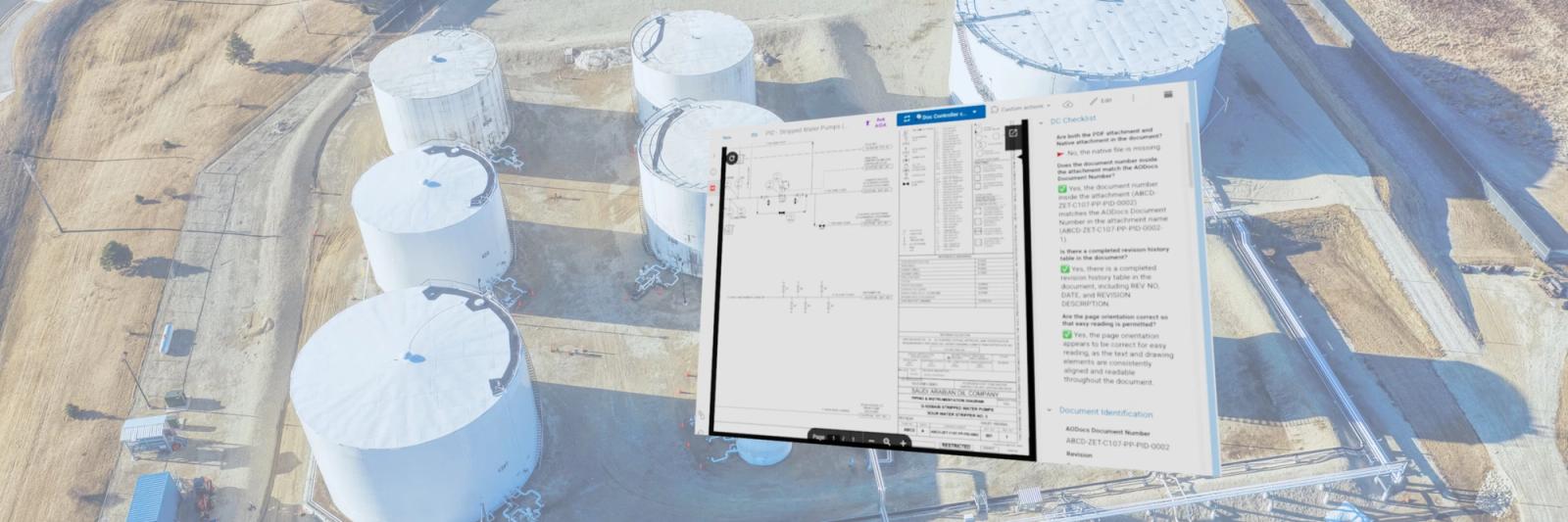
In large-scale energy, engineering and construction projects, document errors can cause schedule overruns and contractor disputes. This article explains how those risks arise, which document controls can reduce them, and how to assess AI-assisted workflows against project requirements.
The document problem is bigger than it looks
On a major capital project, dozens of contractors submit thousands of documents over months or even years. A wrong revision, a missing metadata field, a drawing issued to the wrong supplier, or any other error that seems minor, can trigger an avalanche of rework orders, halted inspections, contractual disputes, and scheduling issues that compound as the mistake cascades downstream. In short, potentially huge risks and losses.
Broader industry estimates do not establish the cost of document errors on an individual capital project. Review the scope and methodology of secondary reporting such as premiercs, then measure the project's own rework, review delays and wrong-revision incidents.
Document-related losses can accumulate through the everyday friction of fragmented document flows: wrong versions reaching site teams, manual review processes that leave a warning overlooked, and contractors waiting on approvals while crews stand idle.
Where the losses actually occur
Understanding the cost requires looking at where document errors enter the workflow, not just where they surface.
Rework driven by document inaccuracy
Poor documentation can contribute to avoidable rework, but a project-specific assessment is needed to establish its share and cost. In energy projects like refineries, power plants, and pipeline infrastructure, this rework often occurs in environments where access is restricted and remobilization is expensive. A drawing error caught during fabrication is manageable. The same error caught during commissioning can trigger weeks of delay.
Time lost searching for the right version
Time spent searching for data, finding errors and checking uncertain information should be measured on the project. On a project with a large site team, this can affect both productivity and the schedule. When a field engineer cannot confirm which revision of a P&ID is the current approved version, work either stops or proceeds on potentially outdated information.
Approval bottlenecks that cascade
Measure project-specific correction costs. Review cycles that rely on email distribution, manually tracked comment sheets, and informal version control slow approvals and create ambiguity about which comments have been addressed (or not).
Fragmentation dilutes control into reporting
Large infrastructure projects operate under documentation requirements that go well beyond basic file management. The common failure mode across all these sectors is fragmentation: drawings in one system, comments in email threads, revision tracking in spreadsheets, and contractor correspondence in yet another tool.
Review the process to identify time spent searching across systems and unresolved revision questions. A Master Document Register should connect required deliverables to their current records, rather than serve only as a reporting artifact.
Manual data entry as a compounding risk
Manually organizing information across systems adds work that should be measured against the project's baseline. In capital projects with active Master Document Registers of thousands of line items, this overhead is not just inefficient. It introduces the error conditions that generate downstream problems.
The common failure mode across all these sectors is fragmentation: drawings in one system, comments in email threads, revision tracking in spreadsheets, and contractor correspondence in yet another tool.
Review the process to identify fragmented searches and manual reconciliation. Keep the Master Document Register linked to current document records, revisions and acceptance evidence.
What structured document control actually prevents
The answer is not more software or the latest AI model. Consolidation that actually works relies on a governed environment where every document, revision, and contractor exchange follows defined rules. A configured system can enforce supported transitions and record their evidence, while people remain responsible for technical decisions and exceptions. The following controls address common failure points; verify their coverage in the project workflow.
Enforced revision lifecycles
Configured lifecycle rules and an audit trail can reduce the risk of outdated drawings reaching field teams. They do not control every downloaded, printed or offline copy. Test supersession through the channels recipients actually use and retain the approval and issue evidence.
AI-assisted quality gates before review
Checking every submitted document against metadata requirements, revision conventions, and file completeness standards is time-consuming when done manually and inconsistent at scale. Configured quality checks can flag missing metadata or rule violations before review. Validate coverage, processing failures and false positives with representative submissions; technical completeness still requires the responsible reviewers.
Controlled comment reconciliation
One of the most persistent sources of delay in construction document review is the reconciliation of comments after a review round: matching reviewer annotations to a comment sheet, tracking contractor responses, and confirming that every comment has a recorded resolution before a new revision can be issued. When these steps are manual, they are slow and error-prone. Where the configured workflow requires recorded responses before progression, test that gate and retain the required comment and decision history. Measure review time separately; a response alone does not establish technical acceptance.
In-platform format support and its dependencies
Engineering projects work in specific formats: DWG, RVT, STEP, SolidWorks, IFC. When teams need external CAD licenses to open and review drawings, access becomes a bottleneck. The AODocs Autodesk Viewer integration supports in-platform viewing, drawing comparison and DWG XREF management. It requires activation and Autodesk Platform Services integration and licensing. XREF extraction also has storage and library-configuration requirements; viewing does not replace CAD authoring or technical approval.
Automated Master Document Register tracking
MDR import, numbering, due-date rules and overdue tracking can support a live project register where configured. Verify available calendar behavior, data mappings and reporting freshness in the licensed implementation.
Document governance is a field operation
Back-office document control is critical at the front line. Field engineers, site supervisors, and commissioning teams make decisions based on the files and content they can access. Evaluate the effects of document-control changes at project level. Track rejected submissions, review duration, unresolved comments, wrong-issue retrieval incidents and handover exceptions against a defined baseline. Retained records can support dispute review and package reconciliation; they do not guarantee shorter cycles, fewer disputes or accurate engineering data.
AI assistants grounded in a governed document library can support field troubleshooting. Test that retrieval respects permissions, approval status and supersession, and require human review for project-critical decisions.
The investment case should use project-specific evidence. Analysis should distinguish document-related rework from other poor-data effects and disclose the population, time period and calculation before estimating savings.
When dealing with large scale capital projects, the cost and risk of a documentation error are extremely high. The investment case for document control is a no brainer, says Stéphan Donzé, CEO and Founder of AODocs.
AI-native document control for capital projects
The discipline of document control on capital projects has existed for decades. Configured automation can support submission checks, metadata extraction and comment reconciliation. Test extraction accuracy on representative drawings and equipment tags, route uncertain results for review, and verify how rejected files and unresolved comments are handled. Measure staff effort and processing time against a baseline; automation does not by itself establish technical completeness or eliminate omissions.
This is the context in which AI-native document management platforms represent a genuine operational change rather than a feature upgrade. The value is not in the AI as a standalone capability but in the combination of enforced document governance and AI automation applied to the specific workflows of engineering and construction projects: from MDR import at kickoff, through review cycles and contractor coordination, to final handover.
Platforms such as AODocs support capital-project document workflows. AODocs describes MDR control, configurable lifecycles, collaboration, AI-assisted checks and equipment-data linking. Its Autodesk Viewer integration supports over 100 design formats, including DWG, RVT and SolidWorks, subject to activation, APS licensing and supported storage/configuration. Verify the required calendar, comment-reconciliation, extraction and export behavior in a representative pilot.
Configure and test the required workflow, revision and contractor-exchange records from first drawing to final as-built. Define the audit scope, retention rules and exception handling; do not assume every action or external channel is captured automatically.
Learn more
- AODocs for Capital Projects
Frequently asked questions
How to improve document control process?
Start with a specific failure, such as an unauthorized drawing reaching site or an unresolved review comment. Define the document identity, authorized state, responsible role and evidence needed for the next action. Test the control through the channels people actually use. Track comparable exception and review-cycle data against your own baseline rather than assuming an industry-wide saving.
Can automated revision workflows eliminate the risk of using the wrong drawing?
No workflow establishes zero risk across all copies and user actions. Configured approval and access controls can restrict the repository’s current-use set, but downloads, offline devices, prints and external systems need their own procedures. Test those routes, preserve the issued revision and record exceptions. Measure the observed control behavior instead of assuming complete risk elimination.
Which measures show whether document-control changes are working?
Define the scope and calculation before comparing overdue reviews, rejected submissions, unresolved comments and wrong-issue retrieval incidents. Record time periods, document populations and workflow-state definitions. Separate a faster review event from actual schedule or cost effects, which need project evidence. A case-specific baseline is more useful than applying an unverified global percentage.