AI at work
AI chatbots: When “I don't know” is the right answer

CEO & Founder, AODocs · Oct 29, 2026
The people who ask AIDA their questions are not chatting for fun.
They are bankers who answer their own clients' questions, industrial groups that cannot pause a production line while someone looks for a procedure, aircraft manufacturers that must be sure an answer never puts an aircraft's safety at risk, or energy companies that cannot run a power plant on approximate answers.
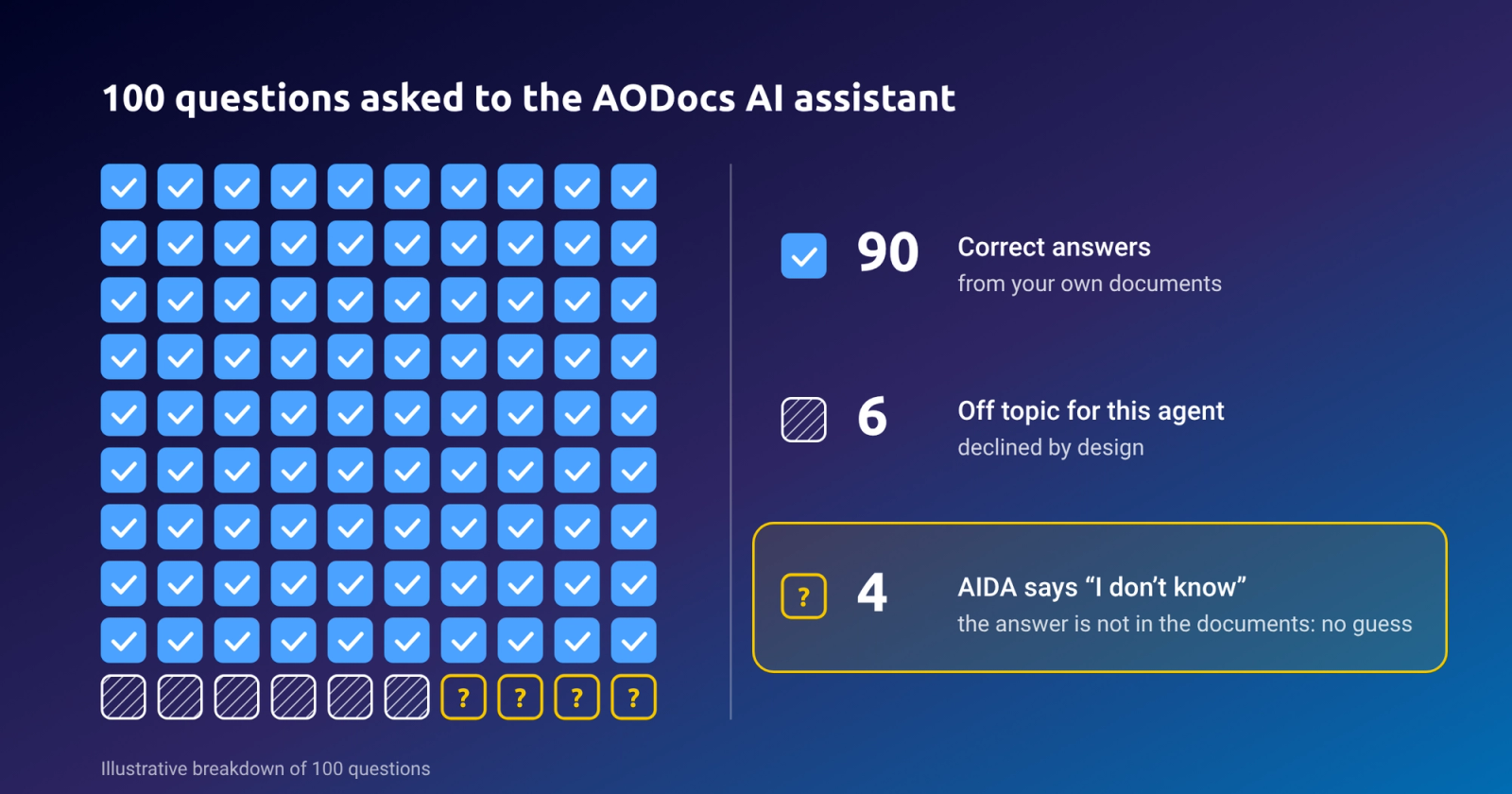
For them, an AI assistant is judged on one question: can I act on what it says? In production, about nine answers out of ten are judged correct. The next question is predictable: why not ten?
Why 100% is the wrong target
Two of the reasons have nothing to do with the AI.
Some questions are off topic for the agent. Give people an assistant and they will ask it anything: the canteen menu, a colleague’s phone number, a rule that lives in another system. An agent is set up for a given domain, and it declines, by design, what falls outside it.
Your documents disagree with themselves. Every company's document estate carries contradictions and gaps: two versions of a procedure still in circulation, a policy updated in one place and not in another, a process everyone follows and nobody wrote down. An assistant that reads those documents inherits them.
On that ground, a perfect score would not be a performance. It would be a warning: it would mean the assistant fills the gaps with text that only looks right.
The most valuable answer: "I don't know"
Generative AI is built to produce an answer. Left to itself, it leans toward assertiveness, a confident tone whatever the evidence, and toward completeness, a full answer even when the sources cover half the question. In a consumer chat, that is a nuisance. In a bank, a plant or a hangar, a plausible answer built on nothing is worse than no answer at all.
AIDA is designed the other way round, whatever model the customer chooses to run it on. It answers only from the documents it can access, and it shows the document it used. When the answer is not in those documents, it says:
"I don't know."
That sentence is one of the hardest things to get from an AI, and one of the most useful. It sends the user to the right person instead of letting them act on a guess. It protects the trust users place in the nine answers that are right. And it is what gives the 90% its meaning: nine answers you can act on, not nine answers lost among ten that all sound equally sure.
What the tenth question tells you
The questions AIDA cannot answer are not noise. Read together, they map where your documents fall short: the procedure nobody wrote, the two versions that disagree, the topic users expect and the corpus does not cover. Each gap closed in the documents is a question answered next time, for every user and every agent that reads them.
That is the difference between an AI that performs and an AI that is governed: the first hides its gaps, the second shows them to you.
When a wrong answer is not an option, nine right answers and an honest tenth beat ten confident ones.
See AIDA on your own documents: request a demo
Frequently asked questions
Why doesn’t AIDA aim for 100% correct answers?
Because two causes of a missing answer lie outside the AI: some questions are off topic for the agent, and every document estate holds contradictions and gaps. An assistant that scored 100% on that ground would be filling the gaps with text that only looks right. About nine correct answers out of ten, with an honest “I don’t know” for the rest, is the score that lets people act on what they read.
What happens when the answer is not in the documents?
AIDA says “I don’t know” instead of guessing. The user is sent to the right person rather than acting on a plausible but unfounded answer. Read together, these unanswered questions show where the documents fall short, so each gap closed becomes a question answered next time.
Which AI model does AIDA use?
The one the customer chooses. AIDA’s behaviour does not come from the model: it answers only from the documents it can access, and it says “I don’t know” when the answer is not there, whatever model runs underneath.