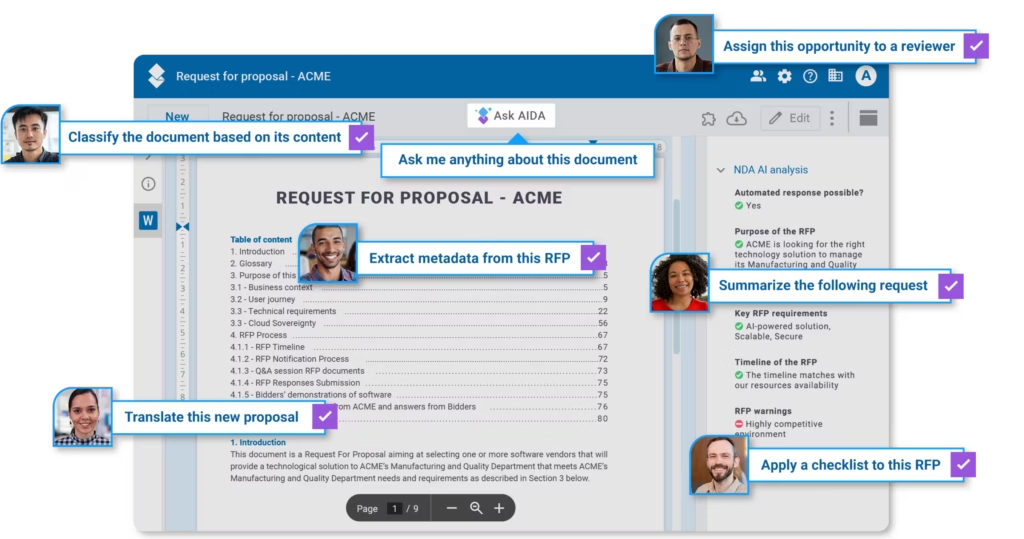

Unite.AI sat down with Stéphan Donzé, Founder and CEO of AODocs, for a deep-dive interview on the future of document management, the evolution of enterprise automation, and how AI agents are speeding up work while ensuring compliance.
Below is a condensed version of that conversation, focusing on the strategic use of AI-powered document automation, AI agents, and the architecture behind AODocs’ success.
Read on for a summary of the full interview, which originally appeared on Unite.AI:
What challenges are companies facing that new-generation DMS platforms can address?
Back in 2012, most enterprise tools were still on-premise and inflexible, especially for managing business-critical documents. Companies loved using new collaboration tools, but they needed more: structure, governance, and automation. We identified this gap and built AODocs from the ground up as a cloud-native platform that could bring modern control and scalability to document-centric workflows.
How can IT and business leaders ensure regulatory compliance and robust governance without sacrificing productivity and collaboration in a cloud-native AI-powered world?
New-gen DMS lets customers keep control of their documents in their own cloud environments. That gives teams the flexibility of modern collaboration while meeting security, compliance, and governance requirements. As a DMS provider, you have to work closely with customers, co-developing features based on real needs, which helps build trust and confidence in adopting a newer solution.
What can enterprises learn from companies that successfully scale document automation?
One lesson is: don’t start with edge cases. Focus on repeatable processes with clear value. That’s how we prioritize what to build—features that meet shared challenges across departments and industries. Success also depends on architecture. Letting customers retain ownership of content while layering on workflow and automation creates a long-term foundation that can scale with business growth.
Where should companies be using AI in their document processes, and where should they be cautious?
Start with areas where AI improves speed and clarity without introducing risk. For example: summarizing long documents, routing files based on content, or spotting missing attachments. We always recommend giving customers control over how AI is applied—full automation for simple steps, human review for the rest. The key is flexibility, so every team can configure the right balance of speed and oversight.
How can organizations ensure AI insights are reliable when working with critical documents?
Grounding is critical. Don’t let AI guess—make sure it only uses validated, up-to-date content. Our approach is to restrict AI to curated sources within the organization, and require attribution for every AI-generated answer. That way, users know exactly where the information came from—and can trust what they’re seeing.
Why are traditional enterprise search tools falling short—and how can AI improve discoverability?
Typical enterprise search drops users into a haystack of results. Chatbots add convenience, but they can confidently give wrong answers if they’re not tied to trustworthy data. We solve this by validating the document sources up front. When you ask a question, the AI isn’t just searching—it’s drawing from controlled, versioned, and approved content. That makes answers more accurate, and far more useful.
Where should enterprise leaders consider deploying AI agents first?
Think about repetitive, high-volume tasks: onboarding, claims processing, document classification, approvals. These are great opportunities for AI agents to boost speed and reduce manual work. In more complex cases, AI can still be valuable—by helping humans work faster with summarized content or suggestions. Our goal is to help companies apply AI where it enhances business outcomes without compromising control and compliance.
What’s the single most important foundation for AI success in document workflows?
Trust in your content. AI is only as good as the data it has access to. If your document base is full of drafts, duplicates, or outdated contracts, you’re going to get poor results. That’s why governance is step one. Once the content is right, AI can deliver real acceleration—without surprises.
Read the full interview here