AI
Document Processing with AI and OCR: Extraction, Review, and Workflows

Industry Lead, Capital Projects, AODocs · Feb 19, 2026 · Updated Oct 20, 2026

Document processing AI OCR combines OCR, which converts scanned documents into machine-readable text, with AI that performs document understanding: classifying raw documents, extracting key information into usable data, flagging exceptions, and routing work with minimal human intervention. The workflow still needs validation and human review appropriate to the business decision.
Optical Character Recognition (OCR) converts text in document images into machine-readable text. Digital PDFs may already contain extractable text. Image-based pages require recognition or image interpretation, and field extraction adds a separate task: identifying the information the workflow needs. An AI processing pipeline may use OCR, image-capable models, or both.
For enterprise teams in finance, legal, engineering, construction, healthcare, and other document-intensive or regulated environments, that gap matters because critical business process workflows depend on turning unstructured data in contracts, invoices, medical records, financial records, and agreements into reliable, governed information.
Document capture tools require implementation and validation suited to the document types, document formats, layouts, and workflow. Assess setup and review effort against representative files rather than assuming one cost profile for every OCR product.
OCR quality depends on the document and scan quality, while field extraction and interpretation add their own requirements. Test varied layouts and scans against the information the workflow needs.
Invoices, contracts, medical records, and agreements arrive in many formats and layouts. Recognized text alone does not establish that the right metadata has been extracted; field values and document context still need validation.
Document capture can still require manual review, correction, and transfer to downstream systems. Different approaches to narrow AI should be evaluated on the document types and workflow they support, rather than treated as interchangeable.
Manual review and re-entry can create document-processing bottlenecks. Digital document organization affects office work. Planning should consider document volumes and variability in each workflow, including the effort needed to check uncertain or incomplete data.
AI-enabled document processing changes that equation entirely. By combining OCR with machine learning, natural language processing, and computer vision, modern Intelligent Document Processing (IDP) can classify documents, extract key information, apply metadata, automate workflow steps, support human validation, and connect document content to knowledge management and downstream systems that synthesize information from multiple sources.
For technology and compliance teams, the test is whether the configured workflow handles the required documents, exceptions, and permissions. Measure extraction quality and review effort before expanding the process. Automation alone does not establish compliance or protect sensitive information.
Human review should be defined for uncertain results and business-critical decisions. The workflow must specify who can approve extracted information and when a case is escalated.
The objective is to turn recognized content into reviewed data that the next workflow step can use.
Where does intelligent document processing make a difference?
Document processing is useful to evaluate where teams repeatedly classify files, copy fields, or check completeness. Select a workflow with a measurable baseline and an accountable reviewer. The examples below are possible uses, not guaranteed results.
Procurement: Extracting fields from contracts and RFPs
Procurement teams deal with a constant flow of supplier proposals, tender documents, and purchase contracts across document-heavy business processes and operational workflows.
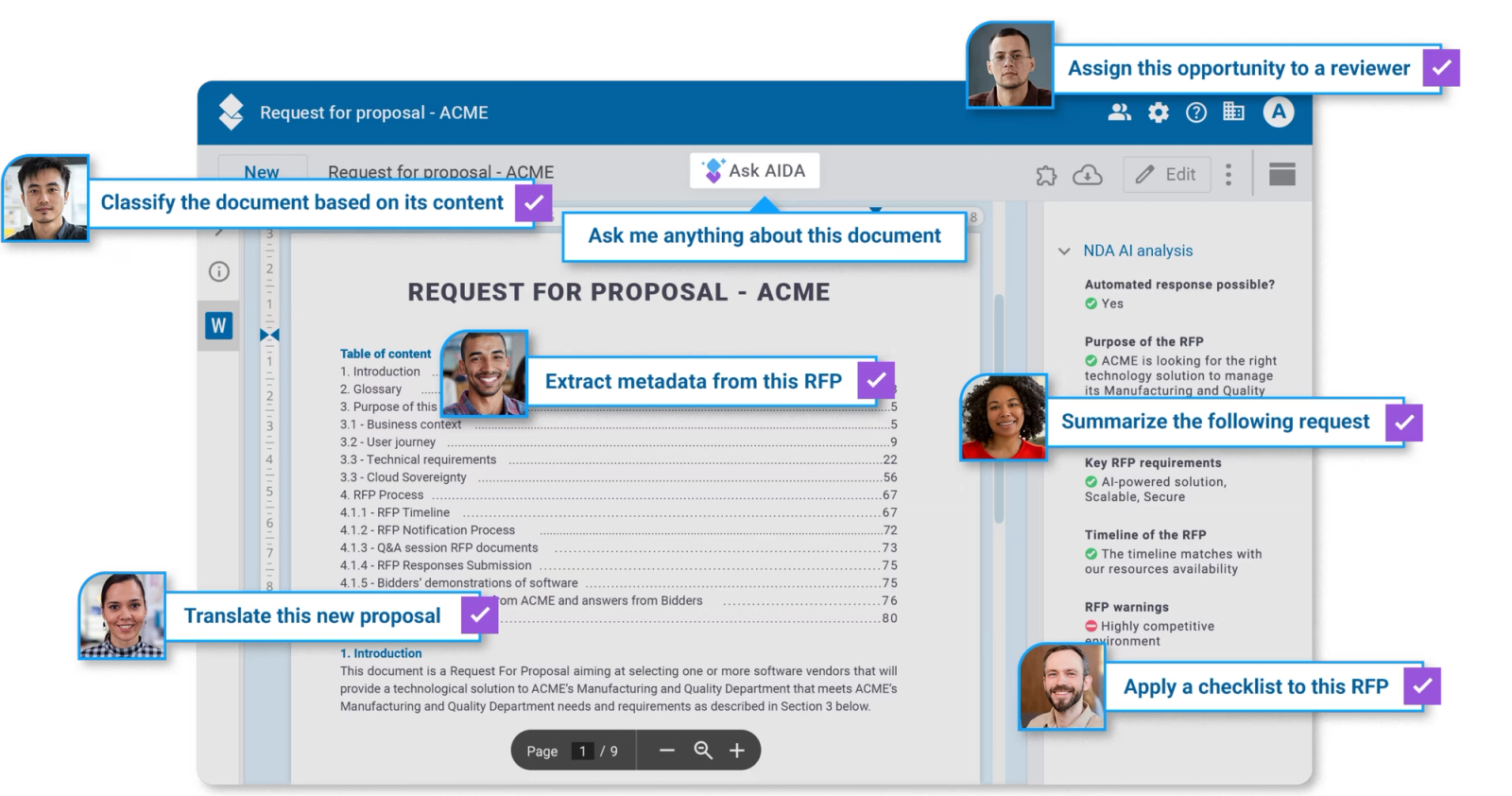
AI can support document classification for incoming RFPs and vendor responses, then extract key information such as pricing, delivery timelines, warranty terms, and sustainability criteria for comparison. These gains apply across common intelligent document processing use cases and across both structured documents and unstructured documents. Where layouts are consistent, document templates can support more reliable structured extraction. Procurement teams should verify the extracted values and source passages before using them in vendor selection; processing time depends on the documents and workflow.
Legal: Reviewing agreements with natural language processing to avoid time-consuming and error-prone manual extraction
Legal and compliance teams face the dual pressure of thorough review and tight turnaround times, whether they are reviewing contracts, legal filings, or other structured documents and more variable unstructured documents.
AI can classify documents and propose fields or clauses for review against defined criteria. A legal reviewer should verify the source text and decide whether an agreement is acceptable. Use confidence scores where the selected tool provides them, alongside business rules and source checks. Reviewer corrections inform evaluation or a supported retraining process; they do not automatically improve every model.
Finance: Capturing loan application data with greater accuracy and speed
Mortgage applications and loan files often require data from income statements, tax returns, and application forms. AI-assisted capture can help prepare these records, but values, missing evidence, and exceptions still need validation before a credit decision.
Automated completeness and consistency checks can help prepare a loan file for review. Validate extracted values against the source and the rules for the application. Layout variation can affect extraction quality. Those checks do not replace the credit decision or establish compliance.
The aim is to reduce repetitive file preparation while retaining review and credit-decision responsibilities. Beyond these three domains, automated document processing delivers meaningful impact across a wide range of industries and workflows. Whatever the use case, IDP is worth evaluating in the functions where document volume, complexity, and business risk converge:
- AI-assisted classification of customer complaints and draft responses for review against the applicable policy.
- Document classification and completeness checks that prepare claims or applications for review.
- Healthcare: Patient data checks, form routing, and draft summaries for clinical and administrative review. Required safeguards and regulatory responsibilities must be assessed for the use case.
- AI-assisted completeness checks, document organization, and caseworker summaries for review.
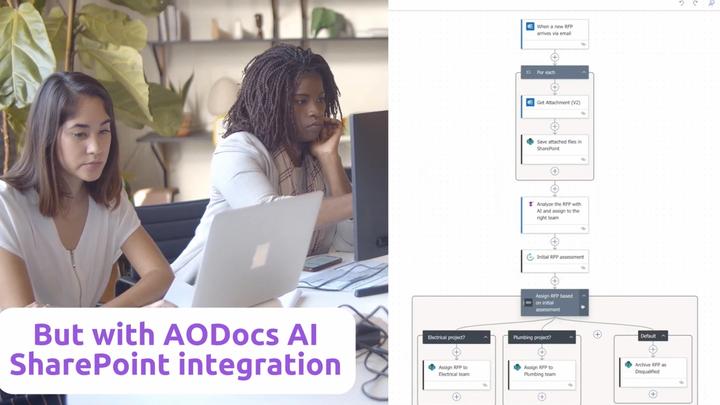
- Sales: Automated RFP response generation and requirement extraction, with intelligent routing to the right team members.
- Accounting: Invoice data extraction and routing to the designated reviewer; matching exceptions and approval decisions remain part of the configured process.
AI in Business Process Automation: Can it become a competitive advantage?
Combining OCR with AI document processing can change how teams prepare and review finance documents, from invoice processing and financial statements to loan files. A traditional OCR engine may read a scanned invoice into text, but reliable field capture still depends on structured extraction, layout analysis, and layout extraction. The following are areas to evaluate in a pilot, rather than outcomes every workflow will achieve:
Faster turnaround times: Classification, extraction, and draft summaries can reduce some manual handling. Measure processing and correction time on representative documents, including failed or uncertain results, and test intelligent document processing software on your own documents. Review the structured outputs and extracted outputs it produces, since those results need to move cleanly into downstream business systems.
Focus on valuable decision-making: When AI handles repetitive, low-value tasks, classification, extraction, summarization, first-level review , your team's time and attention shifts to the complex, high-impact work that actually requires human judgment. In some workflows, robotic process automation can then route approved data and notifications without adding more manual steps.
Scale with confidence: Document volumes fluctuate. Test throughput, exception handling, and review capacity at expected peaks. IDP does not ensure consistent performance or compliance regardless of volume. You also need clear error handling and monitoring, because extraction quality can drift as templates, scans, and document formats change.
Better customer experiences: Reducing document-processing delays can help service workflows. Evaluate response times, corrections, and review effort against the applicable service commitments. Automated completeness and consistency checks should apply validation rules and deterministic validation to each extracted value before review.
Flexibility across document layouts: A new supplier or form layout can change extraction requirements. AI-based processing may reduce reliance on fixed templates, but the new document set still needs testing against the required fields and business rules. That includes checking whether training data and extraction logic still match the incoming files.
AI document processing can interpret varied layouts, including invoices, contracts, and records. Extraction on semi-structured documents can be strong, but it still depends on the document set and review design. That capability does not remove validation: test required fields, tables, and exceptions whenever the document set or workflow changes.
Tying it all in: How to have a whole that's bigger than the parts?
When evaluating intelligent document processing software in a pilot, AI-driven processing and automation doesn't operate in isolation. Teams should test tools on their own documents, not polished vendor samples. It's most powerful as part of a connected, end-to-end document intelligence strategy.
Once documents are processed, classified, and enriched with structured data, the next step is putting that knowledge to work. That's where AI Agents and Knowledge Management come in, enabling teams to query, surface, and act on document insights through intelligent assistants that know your content, your context, and your business rules. Document processing feeds the knowledge layer; the knowledge layer powers smarter decisions. In practice, that often means pulling from multiple sources to generate concise summaries and actions grounded in the right records.
And that's only one dimension of a modern document management strategy. Two more pillars complete the picture:
- Secure external document portals: Share files and collect submissions from external partners through configured portals with document permissions and traceability. The process must define how updates and participant access are managed.
- Modern Document Management with workflow automation: Control projects, cases, and document sets with metadata, versioning, and configured workflows. Connections to SAP, Salesforce, or other business applications require a supported connector or API implementation, permission mapping, and validation of the intended document flow. Ingestion may also need connectors for shared drives, email, and object storage, with authentication and tracking for processed files.
Some models support retraining with labeled examples; others do not. Confirm the supported update process and evaluate a changed model before using it in the workflow.
IDP, knowledge management, external portals, and document workflows address different parts of the information process. Define their responsibilities and integrations. Estimate implementation effort from the documents, systems, permissions, and review requirements in scope.
New-Generation document management systems such as AODocs bring all three pillars together in a single platform, giving teams the tools to process documents intelligently, manage them securely, and act on them confidently.
Learn more
Frequently asked questions
Is OCR obsolete?
No. OCR remains useful for obtaining text from scans and can be combined with AI document processing. Google Document AI, for example, describes a Form Parser that extracts fields and tables in addition to OCR text. Recognizing characters and interpreting document content for a defined workflow are different functions; replacing manual entry does not necessarily remove OCR.
How should extracted data be checked before it enters a workflow?
Check extracted fields against the source document and the workflow’s required format, completeness, and business rules. Route uncertain values, missing information, and conflicting data to a reviewer. Test varied layouts and poor-quality scans before scaling the process. Automation should not turn an unverified extraction into an approved business decision.
Can a new document layout be processed without testing?
A new layout still needs validation, even when an AI model does not depend on a fixed template. Test representative files and confirm that required fields, tables, and exceptions are handled correctly. A system’s ability to interpret unfamiliar content does not prove that it meets the accuracy requirements of a particular workflow.
What is the difference between OCR and AI document processing?
OCR recognizes text in document images. AI document processing can add classification, field extraction, summaries, and workflow preparation. The pipeline may use OCR, image-capable models, or both. Extracted values still need checks against the source and the business rules before they support an approval or other consequential action.