AI
AI Quality Management Use Cases for Governed Enterprise Documents

Industry Lead, Capital Projects, AODocs · Jun 16, 2026 · Updated Oct 13, 2026
Artificial Intelligence in Quality Management
AI quality management use cases for document-heavy teams include checking a draft procedure against defined requirements, preparing evidence for a corrective action, and finding incomplete metadata. These are assistance tasks. Quality owners still decide whether a finding is valid, whether an action addresses the cause, and whether a controlled document can change.
This article focuses on quality documents and their workflows. AI can help teams locate records, compare text, and prepare information for review. Product inspection, equipment monitoring, and formal compliance decisions have separate requirements. Start with a defined document task and test it before extending the scope.
AI in Quality Management: Core Use Cases
Document Review for Quality Compliance
- Use AI to compare a policy with a defined checklist of requirements. Have the responsible quality or compliance reviewer assess every material finding; a comparison does not establish compliance with a law or standard.
- Flag potentially outdated or inconsistent wording for review against the approved procedure and its operating context. Retain the source version and the proposed change.
- Identify missing fields or attachments in an audit-evidence package. Keep missing-item flags separate from a decision about whether the evidence satisfies the requirement.
AI in Quality for Corrective Actions
- Use AI to organize observations and suggest questions for root cause analysis. Validate a proposed cause against the event evidence before selecting corrective action.
- Retrieve relevant approved records and prepare an evidence list for the corrective-action owner. Verify that each record applies to the event and requirement being reviewed.
- Compare recurring issues with historical quality records. Check differences in process, equipment, and scope before treating similar descriptions as the same cause.
AI Agents for Quality Workflows
- Configure retrieval around the procedures the task requires, with permissions and a way to distinguish current instructions from drafts and superseded versions.
- Let an agent prepare a document list or collect proposed fields for review. Define which actions it may take and which require approval.
- Retain the relevant source identifiers, versions, generated outputs, and reviewer decisions so the team can investigate an action.
- Use approved content to draft training material or quiz questions, then have a qualified reviewer check them. A quiz score alone does not demonstrate competence to perform the task.
Data Analysis for Quality Decisions
- Analyze a defined set of quality events to identify candidate patterns. Check data completeness, event definitions, and the period covered before comparing results.
- Look for repeated themes in nonconformance records and investigate them with the process owner. Predictive maintenance based on sensor data is a separate use case and should not be assumed to follow from document analysis.
- Treat a proposed indicator of process drift as a hypothesis to test. Changes to sample sizes or inspection frequency require the responsible quality authority and an appropriate validation method.
- Use text analysis to group customer feedback for review. Test whether the categories capture material complaints rather than treating a sentiment score as a quality decision.
- Bring reviewed findings to management review with the source population, limitations, and unresolved questions. Avoid forecasts that imply a particular level of AI adoption or performance by a future date.
Data Quality and Document Governance
- Use required-field checks and, where appropriate, AI suggestions to identify incomplete metadata. Confirm proposed corrections before they affect routing or reporting.
- Flag possible duplicate procedures for a quality owner to compare. Similar wording can hide differences in equipment, responsibilities, or acceptance criteria; do not merge approved procedures automatically.
- Define naming rules and controlled metadata values around how the team retrieves and reviews records.
- Keep version and approval history when accepted changes are made through the document-control process.
AI Tools for Document-Heavy Quality Teams
- Evaluate an AI-native document management platform against the source access, review, and evidence requirements of the chosen task.
- Check which enterprise repositories the proposed tool can access and how permissions and document status are applied.
- Test extraction on representative file types and layouts. Measure correction effort, omitted fields, and false positives as well as processing time; no general percentage saving is assumed.
- Confirm the supported connection to the existing QMS, including field mapping, record ownership, rejected updates, and reconciliation.
- Use the pilot evidence to decide whether expansion is justified. Industry adoption surveys do not establish the benefit or safety of a particular quality workflow.
Document Review Across Regulated Workflows
- For contract quality checks, use AI document processing to prepare fields and passages for the designated reviewer.
- For supplier qualification, AI-assisted vendor selection can help prepare information for review. The purchasing or quality authority still approves the decision.
- For engineering records, verify document identity, revision, and permitted use. Apply the same evidence discipline when reviewing supplier-selection information.
- Visual inspection with computer vision is a separate quality-control application. It requires representative images, acceptance criteria, and validation; a document-management capability does not establish support for production-line inspection.
- Compare AI-proposed SOP edits with the approved procedure. Check technical steps, roles, and acceptance criteria before routing changes through document approval.
AI Integration with Enterprise Content Systems
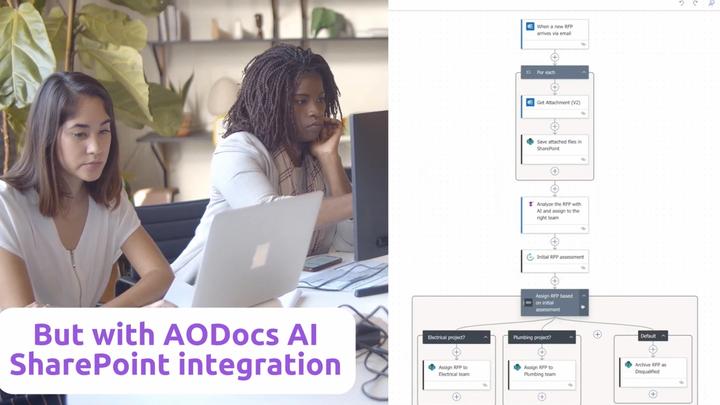
- For AI document processing in SharePoint, identify the service that reads the file, the destination of extracted data, and the review step before action.
- Verify authentication and documented interfaces for each proposed repository connection.
- Test source permissions and access changes with the roles that will use the workflow.
- Test failed transfers, duplicate submissions, retries, and reconciliation. A provider name alone does not prove an integration exists.
AI Integration with Quality Management Systems
- Connect reviewed outputs to the right QMS record. Document management for QMS records can support evidence handling, while the responsible team retains audit and compliance decisions.
- Keep the approval record and the document version it applies to. Audit events are evidence to inspect, not a substitute for the approval itself.
- Test that retrieval respects the permissions and document scope required for each role.
- Record the model or configuration used where available, the source scope, and the output. Re-evaluate the workflow when those elements or the business requirements change.
Human Review and Human Oversight
- Define review triggers in line with the task and the AODocs reference for AI assistants. Escalate missing information, conflicting sources, and actions outside the approved scope.
- Assign qualified reviewers to consequential decisions. Provide the source evidence and authority they need to accept, correct, or reject a suggestion.
- Record the decision and the material reasoning required by the quality process, together with the evidence reviewed.
- Give uncertain results an accountable owner and a resolution route. Feed observed failures into the next evaluation rather than silently accepting them.
Measuring AI Quality Management Performance
- When evaluating quality document management, measure end-to-end handling time, including exceptions and reviewer corrections.
- Measure required-field accuracy, missing evidence, and false-positive findings against a reviewed baseline.
- Compare recommendations with independent human assessments on representative cases, including difficult and out-of-scope inputs.
- Track review findings and unresolved exceptions after rollout. Do not interpret fewer recorded findings as proof that compliance improved.
Implementing AI in Quality Management
- Start with a bounded retrieval or drafting task using an AI assistant grounded in governed documents. Define the source set and the actions that require review.
- Select a controlled content library and connect it to the relevant quality document workflow. Confirm its owners, permissions, and current versions.
- Pilot one measurable workflow with representative records and reviewers. Test the normal path, missing inputs, conflicting evidence, and failed actions.
- Expand only after the quality owner reviews the results and accepts the remaining limitations.
- Repeat the evaluation when the document population, integration, model, or quality requirements change.
Final Thoughts on AI Quality Management Use Cases
- Keep quality professionals accountable for procedure changes, corrective actions, and acceptance decisions.
- Maintain a source set with clear ownership, versions, permissions, and review status.
- Introduce the process to other teams only after their own requirements and responsibilities are defined.
- Evaluate AODocs as the document and workflow layer supporting the quality process. Confirm the required capabilities and integrations in the proposed configuration.
Frequently asked questions
Should AI merge similar quality procedures automatically?
AI suggestions to merge procedures should be reviewed by the responsible quality owner before any approved document changes. Similar wording does not establish identical scope, equipment, roles or acceptance criteria. Compare those differences, retain the approval record and update affected instructions through the existing change-control process.
How should teams review AI-generated edits to an SOP?
Teams should check AI-generated SOP edits against the approved procedure and its operating context. Verify technical steps, responsibilities and acceptance criteria, then route accepted changes through document approval. A clearer sentence is useful only if it preserves the instruction employees must follow. AI output remains a proposed change.
Do AI-generated quizzes prove that employees are competent?
A quiz can provide evidence of understanding, but a quiz score alone does not establish that an employee can perform a task correctly. Quality teams should choose assessments that fit the role and risk, review generated questions for accuracy and retain the assessment results. Use practical demonstrations when the task requires observable skills.
Which AI quality management use cases are suitable for a first pilot?
Choose a bounded document task, such as finding missing metadata, locating evidence, or drafting a comparison between a procedure and a checklist. Define the source set, expected output, reviewer, and escalation path. Test representative cases and correction effort before expanding into consequential quality decisions.