In large-scale energy, engineering and construction projects, document errors can cause schedule overruns and contractor disputes. This article explains how the losses happen, what structured document control prevents, and how AI-native workflows are transforming project delivery economics.
The document problem is bigger than it looks
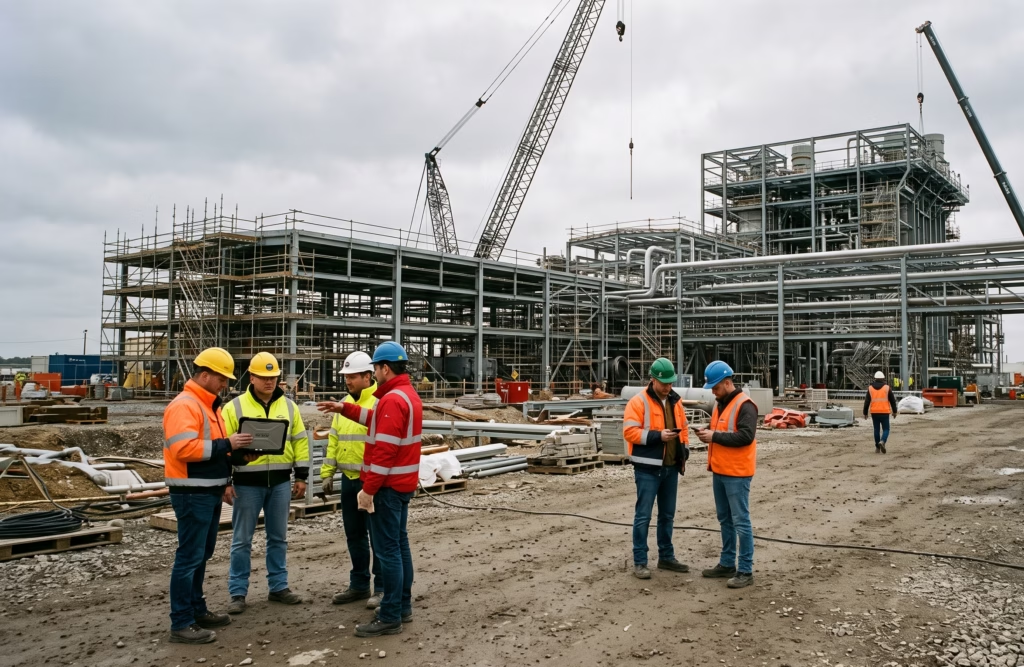
On a major capital project, dozens of contractors submit thousands of documents over months or even years. A wrong revision, a missing metadata field, a drawing issued to the wrong supplier, or any other error that seems minor, can trigger an avalanche of rework orders, halted inspections, contractual disputes, and scheduling issues that compound as the mistake cascades downstream.
In short, potentially huge risks and losses.
Poor document management cost the construction industry an estimated $1.8 trillion worldwide in 2020, and companies generating $1 billion in revenue could lose up to $165 million annually from poor data and content handling alone, per premiercs.
These losses are not driven by catastrophic events. They accumulate through the everyday friction of fragmented document flows: wrong versions reaching site teams, manual review processes that leave a warning overlooked, and contractors waiting on approvals while crews stand idle.
Where the losses actually occur
Understanding the cost requires looking at where document errors enter the workflow, not just where they surface.
Rework driven by document inaccuracy
Poor documentation is responsible for 14% of all avoidable rework in the construction industry, costing an estimated $88 billion globally. In energy projects like refineries, power plants, and pipeline infrastructure, this rework often occurs in environments where access is restricted and re-mobilisation is expensive. A drawing error caught during fabrication is manageable. The same error caught during commissioning can trigger weeks of delay.
Time lost searching for the right version
Workers across construction and engineering projects spend up to 50% of their time looking for data, finding errors, and double-checking information they cannot trust. On a project with a large site team, this is not a productivity issue, but a serious schedule risk. When a field engineer cannot confirm which revision of a P&ID is the current approved version, work either stops or proceeds on potentially outdated information.
Approval bottlenecks that cascade
Nearly half of all avoidable rework in U.S. construction projects stems from poor communication and insufficient project information, costing the industry over $31 billion annually in correction costs. Review cycles that rely on email distribution, manually tracked comment sheets, and informal version control slow approvals and create ambiguity about which comments have been addressed (or not).
Fragmentation dilutes control into reporting
Large infrastructure projects — in civil engineering, industrial construction, and energy — operate under documentation requirements that go well beyond basic file management.
The common failure mode across all these sectors is fragmentation: drawings in one system, comments in email threads, revision tracking in spreadsheets, and contractor correspondence in yet another tool.
Studies show that about 70% of construction workers lose up to 20 hours per week searching across different systems. When this is the norm, the Master Document Register becomes a reporting artefact rather than a live control tool.
Manual data entry as a compounding risk
Construction executives at companies without unified platforms spend thousands of hours per year organising information from different systems. In capital projects with active Master Document Registers of thousands of line items, this overhead is not just inefficient. It introduces the error conditions that generate downstream problems.
The common failure mode across all these sectors is fragmentation: drawings in one system, comments in email threads, revision tracking in spreadsheets, and contractor correspondence in yet another tool.
Studies show that about 70% of construction workers lose up to 20 hours per week searching across different systems. When this fragmentation is the norm, the Master Document Register becomes a reporting artefact rather than a live control tool.
What structured document control actually prevents
The answer is not more software or the latest AI model. Consolidation that actually works relies on a governed environment where every document, revision, and contractor exchange follows defined rules. Moreover, such a system enforces those rules automatically rather than depending on individual discipline.
The key controls that prevent loss are not complicated in concept, but they are consistently absent in projects.
Enforced revision lifecycles.
When a document can only progress from one state to the next according to configured rules, and when that progression is logged with a complete audit trail, the risk of an outdated drawing reaching a field team is eliminated by design.
AI-assisted quality gates before review.
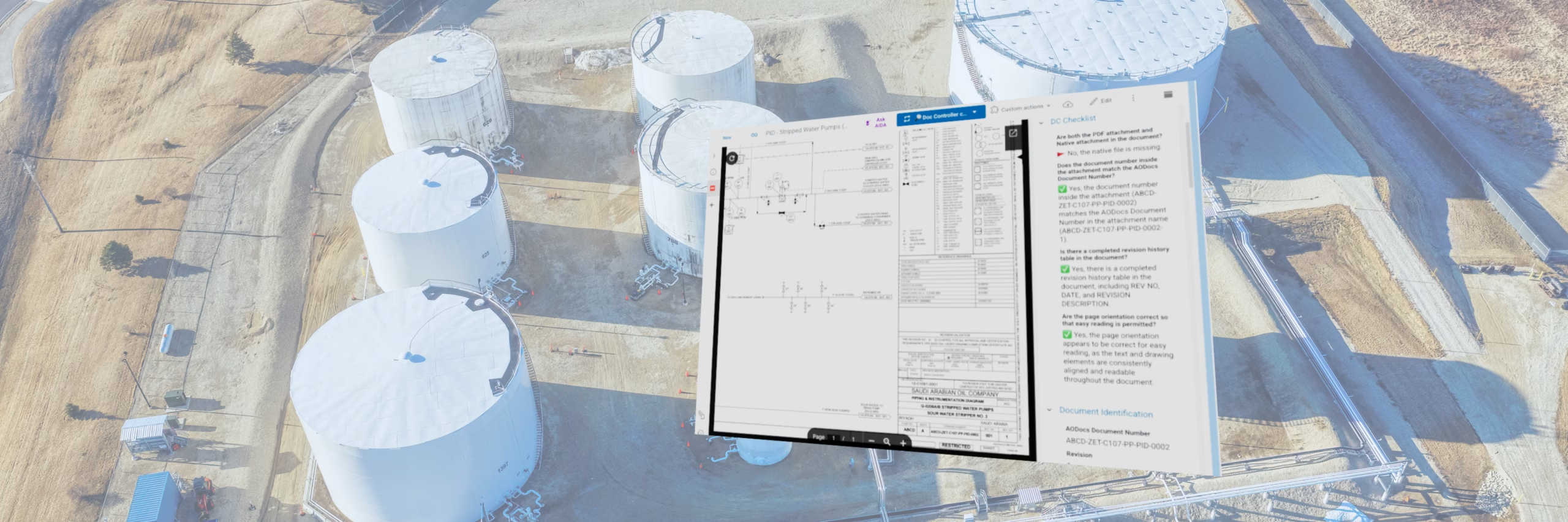
Checking every submitted document against metadata requirements, revision conventions, and file completeness standards is time-consuming when done manually and inconsistent at scale. Automated quality checks run against configurable rules can flag non-conformities the moment a document enters the system, before it consumes any review capacity.
Controlled comment reconciliation.
One of the most persistent sources of delay in construction document review is the reconciliation of comments after a review round: matching reviewer annotations to a comment sheet, tracking contractor responses, and confirming that every comment has a recorded resolution before a new revision can be issued. When these steps are manual, they are slow and error-prone. When they are automated, with the system blocking revision progression until all comments carry a recorded response, the process is both faster and fully traceable.
Native format support without external tooling.
Engineering projects work in specific formats: DWG, RVT, STEP, SolidWorks, IFC. When teams need external CAD licenses to open and review drawings, access becomes a bottleneck. Native in-platform viewing, including XRef resolution and side-by-side revision comparison, removes that dependency.
Automated Master Document Register tracking.
Bulk import, automated document numbering, due date calculation that respects local working calendars, and real-time overdue tracking turn the MDR from a static spreadsheet into a live project control instrument.
Document governance is a field operation
‘Back-office’ document control is critical at the front line. Field engineers, site supervisors, and commissioning teams make decisions based on the files and content they can access.
The downstream effects of well-governed document management are measurable at the project level. Review cycles shorten because non-conforming submissions are caught before they enter the queue. Contractor disputes are reduced because every comment, response, and revision decision carries a traceable record. Handover packages are assembled accurately because the as-built state of every document has been tracked continuously.
AI assistants that draw exclusively from a governed document library, transform the economics of field troubleshooting, where the current alternative is either waiting for a document controller to respond or proceeding on best judgement.
At a broader level, companies that implement formal document management strategies consistently report better returns on their technology investments. Analysis suggests that the global construction industry could save $88 billion annually by preventing rework caused by poor project data.
“When dealing with large scale capital projects, the cost and risk of a documentation error are extremely high. The investment case for document control is a no brainer"

Stephan Donze, CEO, AODocs
AI-native document control for capital projects
The discipline of document control on capital projects has existed for decades. What is changing rapidly now is the degree to which AI can enforce, automate, and accelerate the steps that have historically required manual effort.
Quality checks that took hours now run automatically on submission. Metadata that had to be manually extracted from drawings, equipment tags, reference document numbers, revision indicators, can be captured and linked to an equipment register without human intervention. The grueling and protracted process of uploading, tagging, manually checking, reviewing and reconciling comments involves bundles of dozens of complex documents containing hundreds of annotations that used to consume days of a document controller’s time can be automated end-to-end. Hours of manual work are saved while the risk of omissions and mistakes is reduced considerably.
This is the context in which AI-native document management platforms represent a genuine operational change rather than a feature upgrade. The value is not in the AI as a standalone capability but in the combination of enforced document governance and AI automation applied to the specific workflows of engineering and construction projects: from MDR import at kickoff, through review cycles and contractor coordination, to final handover.
Platforms such as AODocs were natively built for this environment. AODocs capital projects module addresses the full document lifecycle: bulk MDR import with business calendar support, AI quality gates before review, collaborative annotation with automated comment consolidation, contractor response reconciliation, native viewers for over 100 engineering formats including DWG, RVT, and SolidWorks, and automated content linking between documents and the equipment register.
Every action is tracked, every revision is auditable, and every contractor exchange is governed by the same rules as internal review from first drawing to final as-built.
To see how this works in practice across engineering, construction, and energy projects, request a demo at aodocs.com.